International Women’s Haiku Festival: Three Haiku by Marietta McGregor

F D Richards - Alcea rosea, 2017, Single [Hollyhock]
Photo: F. D. Richards/Creative Commons/Flickr
The poignant joy of a girl growing up, the wonder of a child in the womb, and the sorrow lingering long after the death of a special friend all find voice in three wistful haiku by Australian poet Marietta McGregor.

tall pink hollyhocks
daughter swings faster
on the garden gate

As the saying goes, they grow up so quickly. This delightful yet poignant poem conjures the image of a girl who still likes to turn everyday objects – even the garden gate – into playthings. But, as a different saying goes, my, she’s growing like a weed. Or like a hollyhock, which can grow to be quite tall – and quite beautiful.

***

faint new moon
framed in leaves
thirteen-week ultrasound

This tender poem likens the silvery ultrasound image of a child growing in the womb to the hazy glow of the moon. The imagery of darkness and light cloaks the poem in a chiaroscuro fittingly wondrous for the awesome mystery of new life.

***

autumn dusk
the years since we shared
a birthday

This beautiful poem gives voice to the sorrow of losing a loved-one – in this case, one with the special connection of having been born the same day the poetic speaker was – to the final separation caused by death. The poetic speaker and the other person represented by “we” might literally have been twins, or might have been simply “birthmates” unrelated by blood, but they are now separated by death. Even after “the years” since they shared a birthday, the pain of this separation is still fresh, and it is conveyed beautifully in the doubly umbrous image of “autumn dusk.”

Marietta McGregor is a retired botanist and journalist from Canberra, Australia, and a Pushcart-nominated poet. Her award-winning haiku, haibun and haiga appear in international journals and anthologies and have featured on Japanese television. She belongs to the Australian and British Haiku Societies, and the Haiku Society of America.

International Women’s Haiku Festival: Three Haiku by Jessica Malone Latham

wispy clouds
Photo: Indi Samarajiva/Creative Commons/Flickr

Wispy clouds drift over an intimate moment, a frail woman perseveres on a walk through an ancient forest, and the awe in a father’s heart fill three lovely haiku by U.S. poet Jessica Malone Latham.

cloud wisps
the secrets he whispers
in my hair

This beautiful haiku offers a tight shot on a private moment. Music links the poem’s central aspects by way of the sibilants in “wisps,” “secrets,” and “whispers.” That the secrets are whispered in the poetic speaker’s hair, not ear, suggests the untidy sensuality of a deeply intimate relationship.

***

old-growth forest
the stick that holds
her limp

I imagine an older woman limping with walking stick through an ancient forest. Here, subject and setting are linked by worldly experience, by the suggestion that they share the earthy wisdom that comes with years. And while the forest – nature in one of its grandest expressions – is often portrayed as the setting for frightening supernatural events, in this haiku it is a place of comforting solitude, embracing and supporting a late-life journey ever deeper through time.

***

the look in his eyes
as the children fall asleep
night blooming jasmine

Even in dark of night, some flowers blossom. The father figure implied in this lovely haiku is entranced by, and in awe of, his sweetly sleeping children – that, even while asleep, they will grow, blossom, flourish, as will his dreams for them. The poetic speaker observes this moment and shares it with the reader, pulling back the curtain on a domestic scene full of love and wonder.

Jessica Malone Latham, M.A. is a poet, writer, translator, and educator. Her haiku, haibun, senryu, and tanka have appeared in dozens of journals and anthologies. She is the recipient of several awards, including the Vancouver Cherry Blossom Sakura Award (2017), a semi-finalist for the Art of Haiku contest, (May 2017) and runner-up for the Haiku Calendar Competition, where two of her poems were included (2017). She has published three collections: cricket song: Haiku and Short Poems from a Mother’s Heart (Red Moon Press) and chapbooks, clouds of light (wooden nickel press) and all this bowing (buddha baby press).


International Women’s Haiku Festival: Two Haiku by John Hawkhead

Ronnie Robertson - moonlight
Photo: Ronnie Robertson/Creative Commons/Flickr

Vivid imagery and brilliant understatement are at work in British poet John Hawkhead’s “Spring moon” and “ink of night” haiku.

Aided by the white light of the moon – that feminine celestial presence – the poetic speaker goes beyond viewing the implied aftereffects of a woman’s lumpectomy or mastectomy and “explores” the “trail” these scars have left on her body. Against the backdrop of spring – the season of renewal and freshness – the chiaroscuro of the moon’s spotlight beaming through dark of night surrounds the telltale signs of a deadly disease. Hawkhead’s “Spring moon” is imbued with life and death, light and darkness. It is a snapshot of the cycle of life itself, every moment at once new and dying.

Spring moon
I explore the lustrous trail
of her breast scars

***

This poem’s opening line – not the typical “dark of night,” but instead “ink of night” – suggests police fingerprint ink and a grim scene leading up to it. Under the nails of the poem’s subject is “the evidence” of some crime. We might assume the woman is a victim who fought back against her attacker, but is that too facile? Hawkhead’s poem leaves just enough room for interpretation to make it tantalizing.

ink of night
under her nails
the evidence

John Hawkhead is a writer and illustrator from the South West of England. His haiku and senryu have been published all over the world and his book, Small Shadows, is available from Alba Publishing.

International Women’s Haiku Festival: Two Haiku by Debbie Strange

Jackie Finn-Irwin - Purple African Violet
Photo by Jackie Finn-Irwin/Creative Commons/Flickr

Launching the 2018 International Women’s Haiku Festival are two gorgeous haiku by Canadian poet Debbie Strange.

Taken together, these two poems convey volumes about women’s experience. In “sisterless . . .” the special relationship that only sisters can share is viewed from the vantage point of its utter lack, and illustrated with the heartrending image of a star falling into permanent darkness in a lake.

“African violets” is a compassionate take on the parts of our lives that we may prefer to leave in the relative safety and comfort of the vagueness of the past. Likening the “fuzzy details” of the past to bold and beautiful (and, yes, fuzzy) African violets acknowledges that even the shadows of one’s past are still, in their own unique ways, beautiful and brilliant.

sisterless . . .
another star falls
into the lake

***

African violets
the fuzzy details
of my past

Debbie Strange (Canada) is an internationally published short form poet, haiga artist and photographer whose creative passions bring her closer to the world and to herself. She is the author of Warp and Weft: Tanka Threads (Keibooks 2015) and the haiku chapbook A Year Unfolding (Folded Word 2017). You are invited to visit her publication archive at http://debbiemstrange.blogspot.ca/.

“jazz brunch” Haiku Named a “Judge’s Favorite” in 2018 Golden Haiku Competition

It was a pleasant surprise to learn that, again this year, one of my haiku will be displayed in the Golden Triangle district in Washington, D.C., as a “Judge’s Favorite” in the 2018 international Golden Haiku Competition.

Here is my haiku, selected from a record 1,700 submissions from around the world:

Hambrick - jazz brunch

Here are my poems selected in the 2017 Golden Haiku Competition.

I love public art and am thrilled that one of my poems has been selected for this major public art project. My thanks to this year’s competition judges, Abigail Friedman, John Stevenson and Kit Pancoast Nagamura.  And hearty congratulations to my fellow poets whose work was also selected.

A Poetry Commission and an Exciting New Project from the Johnstone Fund for New Music

Toshiyuki Imai Music Sheet httpswww.flickr.comphotosmatsuyuki4317930373inphotolist-7zywgp-Udcg8Q-8xrsLM-aXqoHp-dxRJv8-8xrsSX-8xrsCM-7
Photo: Toshiyuki Imai/Creative Commons/Flickr

I am extremely excited to announce my most recent poetry commission and an invitation to participate in an innovative project to catalyze the creation of new musical works with poetry.

The Big SCORE, a project created and funded by the Johnstone Fund for New Music, pairs six Columbus poets with six Columbus composers, each pair tasked to collaborate on the creation of a new work for chamber ensemble and spoken or sung text.

I am thrilled to be one of The Big SCORE’s invited poets and to have been paired with the phenomenal composer and percussionist Mark Lomax. The other artists invited to contribute to the project are poets Louise Robertson, Jeremy Glazier, Barbara Fant, Dionne Custer Edwards, and Scott Woods, and composers Jennifer Merkowitz, Linda Kernohan, Jennifer Jolley, Michael Torres, and Charlie Wilmoth.

The new works will be premiered in Columbus in spring 2019. I am deeply grateful to Zoe Johnstone for inviting me to participate in this extraordinary project.

“Dementia Unit Art Gallery” Published in The American Journal of Poetry

- free download from pixabay-dot-com

I am deeply honored that my poem “Dementia Unit Art Gallery” has been published in the most recent issue of The American Journal of Poetry.

Dementia is a theme I revisit frequently in my work.  I have not yet found a way to communicate the full scale of devastation that all forms of dementia bring about. So while I despair of the reality of dementia itself, I keep trying to convey the profound feelings of horror, loss, and sorrow that dementia brings about in those whose lives it touches.

In imagistic language and an experimental graphic format, “Dementia Unit Art Gallery” casts a cold eye on the childlike state of cognition and creativity to which dementia relegates its victims.

I am deeply grateful to editor Robert Nazarene for bringing this poem out into the world.

‘concrete jungle’ Haiga Receives Honors from World Haiku Association

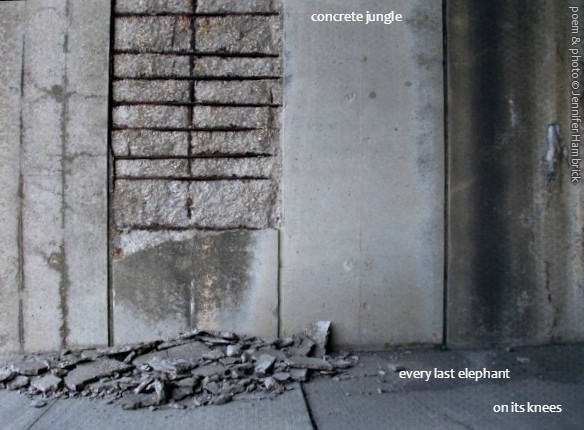
Hambrick - concrete jungle2
‘concrete jungle’ © 2017 Jennifer Hambrick. All rights reserved. First published in the online exhibition of the World Haiku Association’s 159th Haiga Contest, 24 Dec. 2017.

I am greatly honored that my haiga “concrete jungle” has been selected for the online exhibition in the World Haiku Association’s 159th Haiga Contest.

Whether you live deep in the heart of a city, or commute to and from an urban area, we are surrounded by the elephants of the modern world – highways, bridges, overpasses, train tracks, skyscrapers, and all other marvels of engineering. They help us get from Point A to Point B in (usually) record time. They help us maximize vertical space in an overcrowded world. And they help us traverse and even inhabit spaces normally friendly only to fish or fowl.

But while these gargantuan structures my seem miraculous, as products of steel and cement – and no small amount of blood, sweat, and tears – they, like us, are destined to decay and disintegrate.

Ashes to ashes, dust to dust.

I shot the photo in my ‘concrete jungle’ haiga beneath an overpass that spans a busy urban thoroughfare. The pile of concrete shards on the ground at the foot of the wall that supports the overpass is a metaphor for the decay that will eventually claim all things born of the human intellect and made of human hands.

I am most grateful to judge Kuniharu Shimizu for selecting my haiga for this honor.

“nautilus” Haiga Earns Honors from NHK World TV Haiku Masters Series

runner-up for Haiku Master of the Week 12 Dec 2017
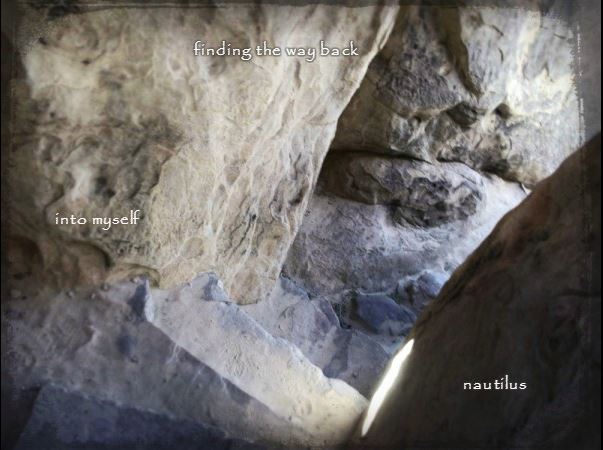
“finding the way back” © 2017 Jennifer Hambrick. All rights reserved. First published on NHK World TV’s Haiku Masters at  https://www3.nhk.or.jp/nhkworld/en/tv/haiku_masters/gallery201712.html?week=2

I am honored to have been named runner-up for Haiku Master of the Week recently on NHK World TV’s Haiku Masters series for my haiga “finding the way back.”

I took the photo for this haiga while descending a rock staircase on a pueblo in New Mexico. The spiral staircase reminded me of the spiral shape of a chambered nautilus, an amazing creature that, as its flesh grows to fill the existing chambers inside, actually creates new chambers to accommodate future growth.

I was intrigued by the idea of growing into oneself as a metaphor for the journey of life. And while the spiral staircase in the photo actually leads outward to light, I read that light as a metaphor for the true enlightenment of coming to know oneself deep within. From my vantage point looking down into them, the spiral steps that lead into the light move clockwise, so I placed the text of the poem on the image so as to move the eye counterclockwise around the image. The haiga, thus, unites text and image in interlocking swirls.

Here are Haiku Masters judge Kazuko Nishimura’s comments on my haiga:

A nautilus grows to fill up the space in its shell, with an interior that can resemble a spiral staircase. This work does a wonderful job of representing the author’s drive to center oneself by returning to one’s origin. The way the text in the photo is written in the shape of a nautilus’ shell is also very well-done,  successfully bringing the photo, text and haiku into one cohesive work.

I am most grateful to Ms. Nishimura for these comments and for bestowing this honor on my work.

‘beefsteak’ Haiga Wins Honors in Jane Reichhold Memorial Haiga Contest

Hambrick - beefsteak
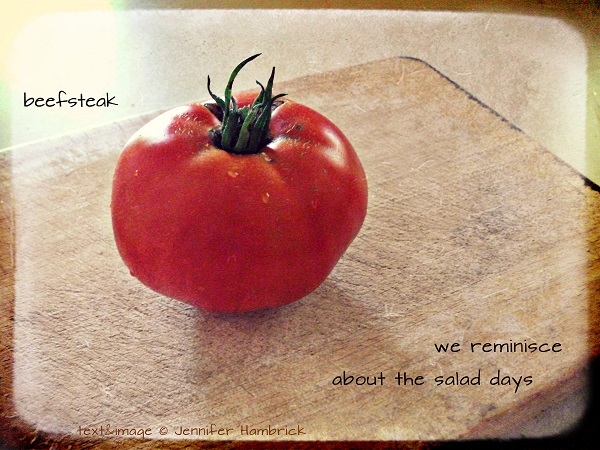
“beefsteak” first published in Prune Juice and Failed Haiku, Nov. 2017.  Poem and photo © Jennifer Hambrick 2017. All rights reserved.

I am deeply honored that my haiga ‘beefsteak,’ above, received first Honorable Mention in the Second Annual Jane Reichhold Memorial Haiga Contest, photographic haiga division.

This particular beefsteak tomato came from my garden, so creating this haiga was a labor of love right from the beginning – from planting the tomato seeds which bore the fruit, to photographing the tomato, to editing the image, to letting the edited image inspire the senryu that now accompanies it.

Here are photographic division judge Linda Papanicolaou’s comments on my haiga:

A salad of self-deprecation and a dash of bawdiness, this is a wonderful example of how good text-image linking can create a synergy that makes a whole that is more than its parts. The poem is all wordplay, from Shakespearean idiom to twentieth century Americanisms, in which tomato referred [to] a sexy woman. It brings an aura of ineffable mystery and sacrament to the whole. The named variety hints punningly at “beefcake,” slang for a well-muscled man. The image, illustrating not the meaning of the poem but just the literal meaning of the first line–a tomato on a chopping block–layers the poem by framing the reminiscence as a conversation during food preparation.

My deep gratitude to Linda Papanicolaou, editor of Haiga Online, for selecting my haiga from among the 132 entries in her division, and for her kind and insightful words about my work. Deep thanks also to editors Steve Hodge and Mike Rehling, whose journals Prune Juice and Failed Haiku, respectively, sponsored the contest, and who have published my honored haiga in the most recent issues of their journals.