Jennifer Hambrick performs with the Worthington Chamber Orchestra
I had the distinct honor recently to give return performances as poet and narrator on “Frontiers of Sound,” the Worthington Chamber Orchestra’s first masterworks concert of the 2025-26 concert season.
Jennifer Hambrick, Zoe Johnstone, and Jack Johnstone
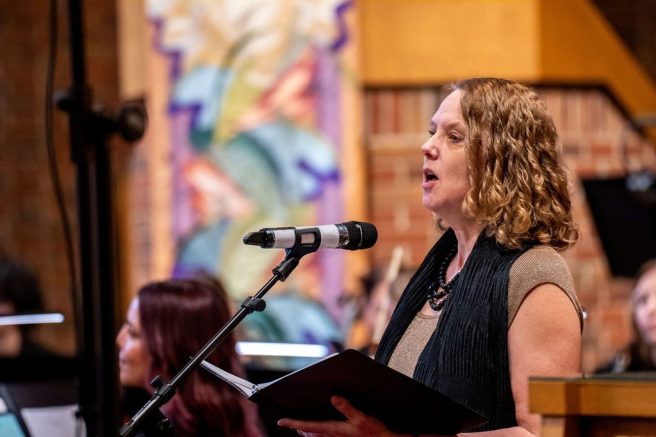
To open the concert, I performed my poem “Nightwalk,” commissioned by the Worthington Chamber Orchestra and supported by the Johnstone Fund for New Music. I am most grateful to Antoine Clark, artistic director and music director of the Worthington Chamber Orchestra, for inviting me to collaborate again with him and the orchestra, and to Jack and Zoe Johnstone for their generous support.
Reading my commissioned poem “Nightwalk” to open the 2025-26 season of the Worthington Chamber Orchestra
The theme of the season’s first concert, “Frontiers of Sound,” took a close look at America’s pioneering spirit and rich history. The program’s poetic and musical offerings reflected this theme in my commissioned poem, and in musical works honoring America’s spirit of innovation. I served as narrator on an orchestration of the Old Worthington Suite by the late Marshall Barnes, former professor of music theory and composition at the Ohio State University School of Music. Composed originally for narrator, flute, clarinet, and piano, and the orchestra, Barnes’ Old Worthington Suite glowed from within in Worthington composer Jacob Reed’s lush orchestration.
Also on the concert were Aaron Copland’s Billy the Kid, along with adventurous musical works by contemporary American composers Aaron Quinn and Jerod Impichchaachaaha’ Tate.
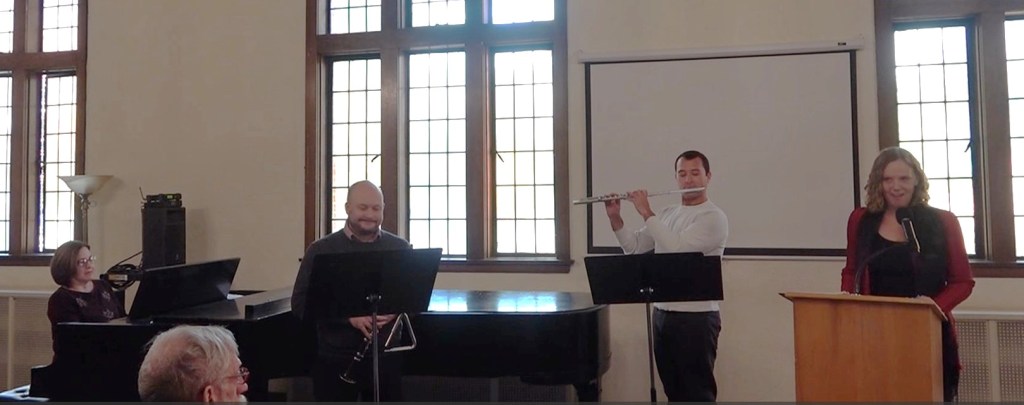
Narrating the original chamber ensemble version of Old Worthington Suite by Marshall Barnes, on the Worthington Chamber Orchestra’s “Frontiers of Sound: Community Connect” event
An accompanying event, Frontiers of Sound: Community Connect, brought the Worthington community together for a performance of the original chamber ensemble version of Barnes’ Old Worthington Suite, in which I performed as narrator. In my WOSU Classical 101 role, I also a panel discussion about historic Worthington’s past and present.
“Frontiers of Sound” marked the first concert of the orchestra’s season-long America250 celebration. The season’s concerts are united under the theme American Crossroads and explore in music the last 250 years of U.S. history and Worthington’s past, present and potential future.
Moderating a panel discussion on the Worthington Chamber Orchestra’s “Frontiers of Sound: Community Connect” event
I am extremely honored and humbled that my most recent book, a silence or two (Red Moon Press), has received a 2025 Merit Book Award from the Haiku Society of America.
According to the Haiku Society of America, the HSA Merit Book Awards “recognize the best haiku and related books published in a given year in the English language.”
a silence or twois a deeply intimate poetic statement. It is raw, visceral. It deals with subject matter at once personal and universal—the body and its failings, trauma, death, loss, identity, and ultimately, the state of fractured wholeness so deep a part of our shared humanity in a broken world. This collection manifests in imagery and narratives that transcend the “objective realism” common to haiku to explore precarious terrain—namely the often unvoiced emotions hidden where flesh, soul, and spirit intersect in the depths of embodiment—for which expected languaging and usual modes of discourse are often insufficient.
Rattle poetry journal editor Tim Green and I discuss a silence or two extensively on Rattlecast.
It is significant that the emotional journey of this collection unfolds in haiku and short prose poems. Haiku tends to be viewed by poets and non-poets as a sort of toss-off genre unworthy of the kind of deep and rigorous study poets and literary scholars routinely devote to other genres. This common misconception and others, however, overlook centuries of profound and profoundly moving poetry in haiku’s original Japanese traditions and in the more recent though vibrant English-language tradition, to which the likes of Richard Wright, Sonia Sanchez, Jack Kerouac, Gary Snyder, and Jane Hirshfield have made significant contributions.
Common misconceptions about haiku also fail to consider that, like all other artistic genres and mediums, haiku invites exploration and the expansion of expressive possibilities. Indeed, haiku is a poetic vehicle uniquely and powerfully suited for conveying extraordinary ways of seeing the world and giving voice to the limitless depths of human emotion.
On every page of a silence or two, I broke the cardinal rules of English-language haiku and pushed other boundaries in ways that some would see as taboo. I am hugely gratified that HSA Merit Book Award competition judges Scott Mason and Patricia Machmiller saw the value of those risks for this book as a work of art and for the genre of haiku in English more broadly.
My deepest thanks and a deep bow to them. Deep thanks also to Jim Kacian and Red Moon Press for publishing this collection.
The “Creative Space” column in Columbus Monthly magazine, April 2025. Story by Peter Tonguette, photography by Tim Johnson. This photo by Jennifer Hambrick.
Written by veteran arts writer Peter Tonguette, the “Creative Space” column highlights the unexpected spaces where selected Columbus artists find inspiration while creating new work. As Tonguette wrote, I found creative and gustatory nourishment to complete a poetry commission at The Whitney House restaurant, in Worthington.
The poems I drafted at The Whitney House update the sonnets published with the concertos, exploring the seasons of contemporary relationships in a blend of nature imagery—a nod to the original sonnets—and images drawn from present-day urban experience.
Every work of art is a mixture of countless silent and invisible ingredients—years of training, hours and hours of deep thought, the magic of inspiration. The place where the artwork was made, the environment that nurtured the artist’s ideas into new expressions, is almost never mentioned in an artwork’s creation story. But now it’s part of the story. Columbus Monthly’s “Creative Space” column is a testament to the creative vibrancy of Columbus, where art is nurtured where you’d least expect it.
If walls could speak.
Deep thanks to Peter Tonguette for featuring me and to photographer Tim Johnson for working his magic.
Jennifer Hambrick reads on Lit Youngstown’s First Wednesday Readers Series, March 2025
It was an honor to give a featured poetry reading recently on Lit Youngstown’s First Wednesday Readers Series. My deep thanks to the wonderful Karen Schubert, Lit Youngstown founder and executive director, for inviting me to read.
Currently in its tenth year, Lit Youngstown enriches northeastern Ohio with a wide range of literary offerings, including readings, book discussions, writing workshops and camps, and a Fall Literary Festival encompassing writing in all genres. Each month Lit Youngstown’s First Wednesday Reader’s Series hosts readings by established writers in and beyond Ohio.
Learn more about Lit Youngstown on this episode of The Casey Malone Show, Youngstown’s arts and culture TV program, which filmed the segment during my reading on the series:
Poetry can happen anywhere – on the page, on the stage, in libraries, coffee shops, parks – even bowling alleys. Wherever there is a heart that bursts into poetry and ears and/or eyes to take it in, poetry has a home. And where there is poetry, there is the possibility to step out of our comfort zones, approach new ways to experience the world, and grow in empathy.
I had the great honor and pleasure recently to join Tim Green, editor of Rattle poetry journal, as featured guest poet on his livestream, Rattlecast.
Tim and I had a really fun genre-bending conversation about poetry, music, and how music and my work as a classical musician, broadcaster, and cultural journalist informs my work as a poet – and vice versa. We also talked about how my work with music – and my mysterious poetry guardian angel – helped me become a poet in the first place. And I read from my most recent poetry collection, a silence or two.
Our conversation about words and music took place just before the publication of Rattle #85, which features a Tribute to Musicians, in which my poem “My Daddy Was an Appalachian Folksong” appears.
When I write poetry, I aim to make music with words. I spend a good deal of each day thinking and writing about music and considering how the sounds of words and the shapes of phrases and sentences can add up to vibrant writing that dances on the page and rattles in the mind’s ear.
The rhetoric of the physical body here is not strictly metaphorical. Poetry and music offer us powerfully embodied experiences as they work on and in us. We feel certain ways when we experience poems and music, and those feelings are emotional and physical.
I’ve always been fascinated by the sounds and feel of words, and also by how those sounds and feelings have come to mean what they mean. I was the kid who wondered, Gee, why do we call the sky “sky?” How did those particular letters and those particular sounds come to signify the great big blue expanse overhead? And how did “blue” come to signify the color of sky? Why not call it something else? And why call toes “toes?” Why call buttons “buttons?”
Of course, we can trace etymologies and find at least some of the ancestors of the words we speak and write today. But if I were to be teleported back in time and given the opportunity to meet the first person who ever spoke the proto-word that became “sky” or “toe” or “button,” I would ask him or her, What made you think to call this thing by these sounds?
Deep thanks to Tim Green for giving words space to dance and sing in the pages of Rattle, and for inviting me to share some of my words on Rattlecast.
I am extremely excited to announce the publication of my most recent poetry collection, a silence or two, by Red Moon Press.
Hailed as “a stunning collection … destined to become a haiku classic,” a silence or two mines the territory of loss, healing, transformation, and joy in haiku and short prose poems that take the haiku form and narrativity between genres into new expressive ground.
Read advance praise for a silence or two from Cherie Hunter Day, Dr. Richard Gilbert, and Michelle Tennison and check out my other books on the Books page. You can also purchase copies from there (click on the book cover images) and through the Order page.
My deepest gratitude to Jim Kacian, founder and president of The Haiku Foundation and publisher at Red Moon Press, for guiding this collection into the world with such patience and care.
I’m humbled to have received four First Prize honors, three Honorable Mentions, and a Special Award for haiku recently in the inaugural Heliosparrow Haiku Frontier Awards.
All of the awarded poems and the judges’ fascinating and extremely rich commentary on them are published in Helioparrow Poetry Journal and in the flipbook at this link.
The awards were created by Dr. Richard Gilbert, professor emeritus of English, Kumamoto University, and one of the world’s leading theorists and critics of contemporary English-language haiku, “to present and praise leading-edge poems and poets illuminating inspiring directions in haiku poetics.”
All of the poems under consideration for the Frontier Awards were published in Heliosparrow Poetry Journal – the world’s leading publication of avant-garde English-language haiku and poems in related genres – which Gilbert founded and edits.
Gilbert, Heliosparrow co-editor Clayton Beach, and poet Michelle Tennison served as judges for the haiku, alterku (poems that expand the haiku form), sequence/collaborative poem, and short poem categories in the contest. I was also honored to judge the haibun category, and to join Gilbert, Beach, and Tennison in judging the alterku and sequence/collaborative poem categories, in which my own work was not in the running.
Far from traditional haiku rooted in the seasons of the non-human natural world, the poems recognized in the inaugural Heliosparrow Haiku Frontier Awards reinterpret the traditional haiku form through daring language, startling imagery, bold disposition on the page, and challenging subject matter and psychological nuance.
To read these poems is to look into the future of English-language haiku.
from director Pat van Boeckel’s film inspired by Marjorie Buettner’s haibun “Unremembered,” first screened at the Haiku North America 2023 Haibun Film Festival.
I had the tremendous pleasure recently to serve as program chair for the 2023 Haiku North America (HNA) conference. As a writer of haibun – a Japanese hybrid genre of haiku and prose – and inspired by the wealth of video poems, haiku films, and work in a rich array of other types of work joining poetic writing and visual art, I was inspired to create for HNA the world’s first festival of haibun films.
The HNA Haibun Film Festival took place 29 June 2023 in the beautiful eleventh floor Reading Room of the Mercantile Library of Cincinnati and featured screenings of nine original films inspired by the haibun of five authors. The films selected for the HNA 2023 Haibun Film Festival were posted on Moving Poems shortly after the conclusion of Haiku North America.
My reasons for creating the HNA Haibun Film festival were many. As I remarked in my introduction to the Haibun Film Festival session, “I hypothesized that not only could haibun films realize latent potential of written haibun texts in the filmic dimension, but also that doing so could bring a certain freshness to a literary genre still finding its footing in English and essentially defunct in its native language, Japanese.”
The text of my introduction to the HNA 2023 Haibun Film Festival outlines my rationale for creating the HNA Haibun Film Festival, details the collaborative two-round competitive selection process that led to the final slate of films screened in the festival, and lists the haibun authors and filmmakers whose work was selected for it:
Why haibun films? There’s the obvious ‘why not?’, especially when you consider that haiku films and other types of video poem are nothing new and are vibrant and seemingly limitless pathways for poetry into the stimulating realm of interdisciplinary symbiosis.
And the linking and shifting between a haibun’s haiku and prose – or a haibun’s non-haiku parts – can expand haibun’s narrative and expressive potential into the visual realm and the performative and temporal planes embodied in film.
In creating this, the first-ever haibun film festival, I hypothesized that not only could haibun films realize latent potential of written haibun texts in the filmic dimension, but also that doing so could bring a certain freshness to a literary genre still finding its footing in English and essentially defunct in its native language, Japanese.
The results of this project – which we’ll view this hour – will, I hope, inspire those who have not written haibun to explore this genre’s creative possibilities as seriously as they might explore other genres, like haiku, and to create haibun films as solo or collaborative enterprises.
The short haibun films you’ll see were catalyzed and selected though a multi-stage, internationally competitive process. Last year, Haiku North America sent out a call for submissions of unpublished haibun. We received 229 submissions in response. I asked Jim Kacian [founder and president of The Haiku Foundation and founder and owner of Red Moon Press] to serve with me as haibun co-screener, in light of his deep roots in the haibun soil, and also in light of his work in haiku films – thank you, Jim. A moment here also to thank Paul Miller [HNA director and editor of Modern Haiku] for anonymizing the submissions before sending the haibun texts to Jim and me, and also for communicating directly with the writers who submitted haibun.
In a “double-blind” screening, Jim and I first narrowed down the 229 submissions to around 40-50 haibun. We eventually selected ten haibun for their merits as pieces of writing in this genre – interesting stories told in vivid prose and well-crafted haiku. I was also interested in feeling a certain space where the actual words on the page left off and potential visual responses to the texts – not merely visual renderings or reenactments of them – might pick up.
The titles and contest entry numbers of the ten selected films were sent to Dave Bonta, founder of the video poem website Moving Poems and author of the haibun collection Failed State (Via Negativa Books).
I’d like now to acknowledge the authors of the ten haibun that Jim Kacian and I selected to send to Dave and Moving Poems, in alphabetical order by author last name:
The Gone Missing – haibun by Joseph Aversano, five different films by: Beate Gördes, Janet Lees, Peter Johnston, EnD, and Marilyn McCabe Circuition – haibun by Mona Bedi Unremembered – haibun by Marjorie Buettner, film by Pat van Boeckel Of Demons and Angels – haibun by Penny Harter The Chase – haibun by Bob Lucky The Longest Journey – haibun by Bob Lucky, film by Pete Johnston Table for One – haibun by Carol Ann Palomba, film by Matt Mullins *Film Awarded Best of Show Hypnic Jerk – haibun by Alan Peat, film by Jack Cochran, Pamela Falkenberg The Layout – haibun by Beth Skala Haven – haibun by Laurie Wilcox-Meyer
Dave posted a call for film submissions on FilmFreeway and formed a committee to screen the film entries. I’d like to thank Dave for organizing the film part of this project and for serving with the award-winning poets and filmmakers Jane Glennie and James Brush to judge the films that were submitted.
Dave, Jane, and James selected nine haibun films, which Dave will screen for us today.
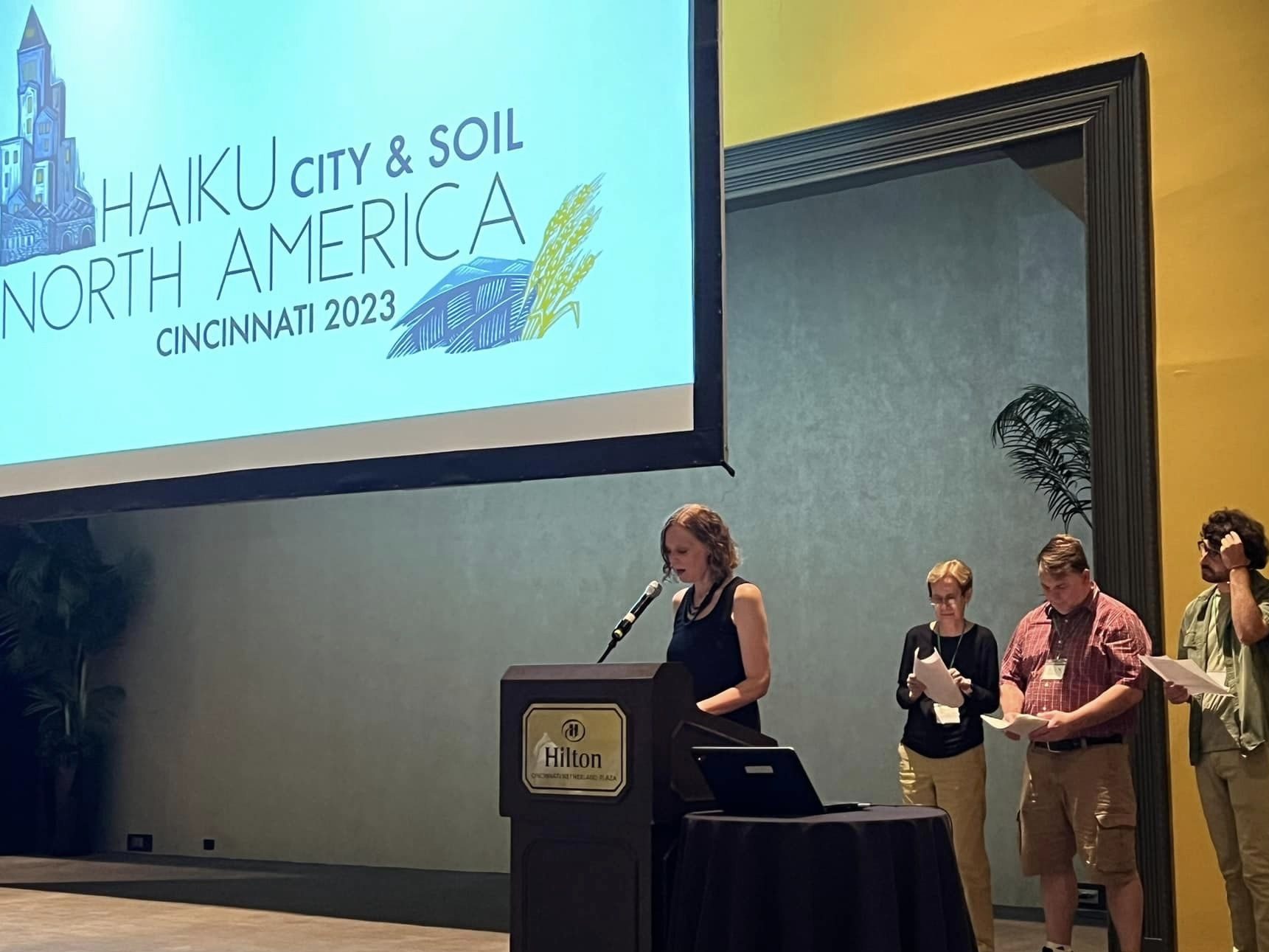
Jennifer Hambrick reads during the Ohio Poets Welcome, Wednesday, June 28, at Haiku North America 2023, in the Pavillion Ballroom of the Hilton Netherland Plaza, Downtown Cincinnati. Also pictured: Patti Niehoff, Elliot Nicely, Nicky Gutierrez. (photo: Holly Brians Ragusa)
Okay, everyone, I did a thing.
For the last two years, I’ve been serving as program chair for the 2023 Haiku North America conference. Two weeks ago, the Program Committee, which I led, and a statewide team of poets brought the conference to fruition, June 28-July 2, 2023, in Cincinnati.
Haiku North America (HNA) is the world’s largest gathering devoted to English-language haiku and related genres. Since 1991, the biennial conference has taken place in cities across the United States and Canada. This year’s conference marked HNA’s Ohio debut and only its second appearance in the Midwest.
As program chair I was tasked with leading a committee of Ohio haiku poets to create the conference program, including devising the conference theme (City & Soil), ideating topics for conference sessions and other events, inviting presenters, selecting proposals from those submitted by prospective presenters, finalizing the conference program, and implementing the program over the five days of the conference at the beautiful Mercantile Library of Cincinnati and the historic Hilton Netherland Plaza, in Downtown Cincinnati’s Carew Tower.
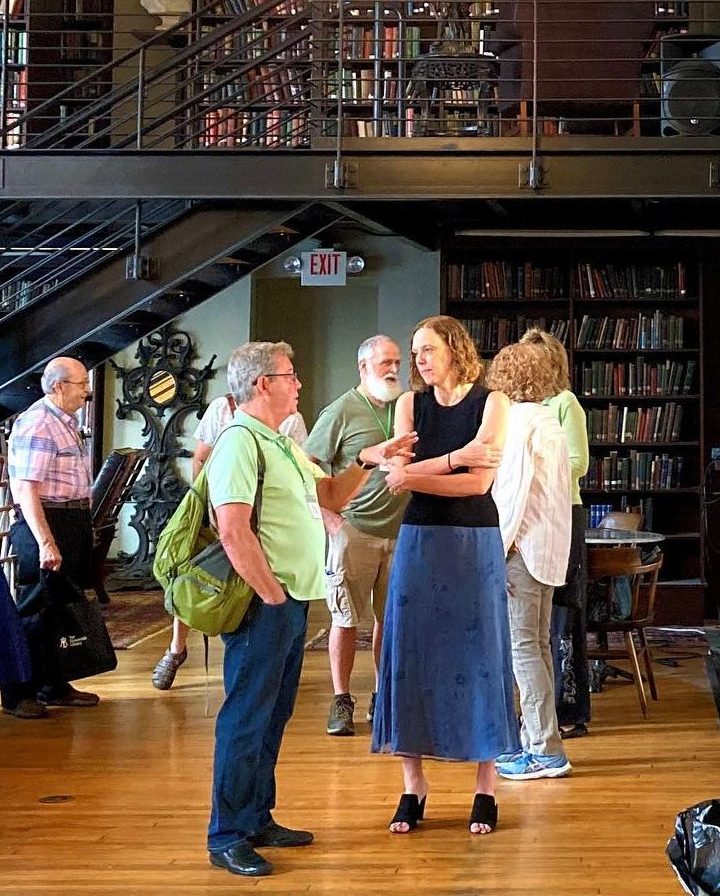
Lew Watts (left) and I converse in the beautiful eleventh floor reading room of the Mercantile Library of Cincinnati before the start of Thursday’s sessions at Haiku North America 2023. (photo: Ben Gaa)
Serving with me on the Program Committee were poets Elliot Nicely (Lakewood) and Nicky Gutierrez (Akron).
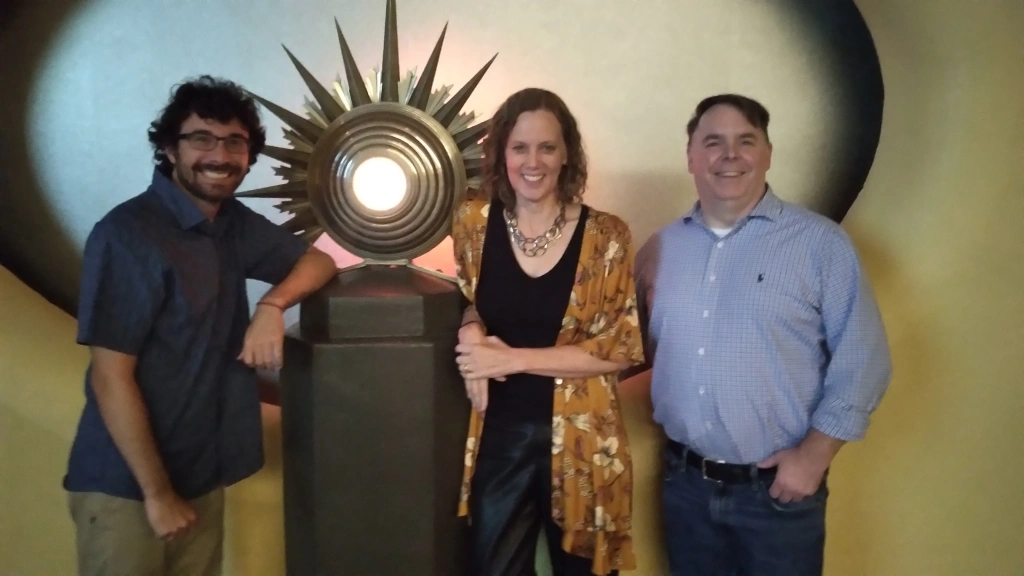
The HNA 2023 Program Committee: Nicky Gutierrez, Jennifer Hambrick (chair), Elliot Nicely (photo: Joe McKeon)
Over a two-year planning period, the Program Committee worked in concert with local arrangements chairs Patti and Buck Niehoff of Cincinnati to bring about all aspects of the conference. I am extremely proud of the work the Program Committee did to create the conference program. Here are some highlights:
Haibun Innovationspanel. Haibun is a genre at once still finding its footing in the English language and poised for great things. As a haibun enthusiast and an award-winning haibun author, I wanted to showcase some of the exciting creative possibilities for haibun and, thus, ignite interest in the genre among the audience at HNA. I assembled a panel of some of the most important writers working in English-language haibun today to share thoughts about the present and future of this genre. In my presentation “Narrative Hybridity in English-Language Haibun,” I offered a new theoretical framework for narrative polyphony in haibun and explored the implications of kire and disjunction in the form. I invited Lew Watts, haibun co-editor of Frogpond, the journal of the Haiku Society of America; Rich Youmans, editor-in-chief of Contemporary Haibun Online; and poet and video poem specialist Dave Bonta to join me on the panel and share their perspectives on new perspectives on the nuts-and-bolts elements of haiku and prose in the haibun genre, recent formal innovations in haibun, and the intersection of haibun and film, respectively. My thanks to Jim Kacian, founder and president of The Haiku Foundation and a poet with deep roots in English-language haibun, for agreeing to moderate the Haibun Innovations panel.
The world’s first-ever Haibun Film Festival. I wanted to take haibun to the next level as an art form in interdisciplinary conversation with the visual, temporal, and performative art form of film. To that end, I created the world’s first-ever Haibun Film Festival at HNA 2023. The initiative called for submissions of unpublished English-language haibun that could serve as the basis for original short films. I invited Jim Kacian to join me in adjudicating the anonymized haibun submissions for the Haibun film Festival session at HNA. And I invited Dave Bonta to publish a submissions call to his video poem community for short films based on the selected haibun and head up a committee to adjudicate the submitted films. Watch for the more about the HNA 2023 Haibun Film Festival, including the selected films themselves, in a future post.
The Higginson lecture by Tim Green, editor of Rattle, with a guest appearance by Katie Dozier, curator of the NFT Poetry Gallery. The HNA executive board selects the Higginson Lecturer, and this year’s speakers offered an intriguing rationale for publishing (minting) haiku in the virtual realm as non-fungible tokens (NFTs).
The Keynote Address, “Dissolving Boundaries: Haiku and Embodied Care,” by scholar and haiku poet Ce Rosenow. Dr. Rosenow’s talk explored the intersection of haiku and care ethics, and offered a path for extending haiku beyond the page and into the world as acts of care.
Cultural Journeys in African American Haiku Dr. Ce Rosenow and poet Crystal Simone Smith lead a fascinating and vitally important discussion of the various cultural elements that inform African American poets writing haiku today.
Ohio Haiku Poets Reading. Ohio boasts a large number of poets writing haiku. This reading featured and celebrated the haiku of dozens of poets from all corners of the state.
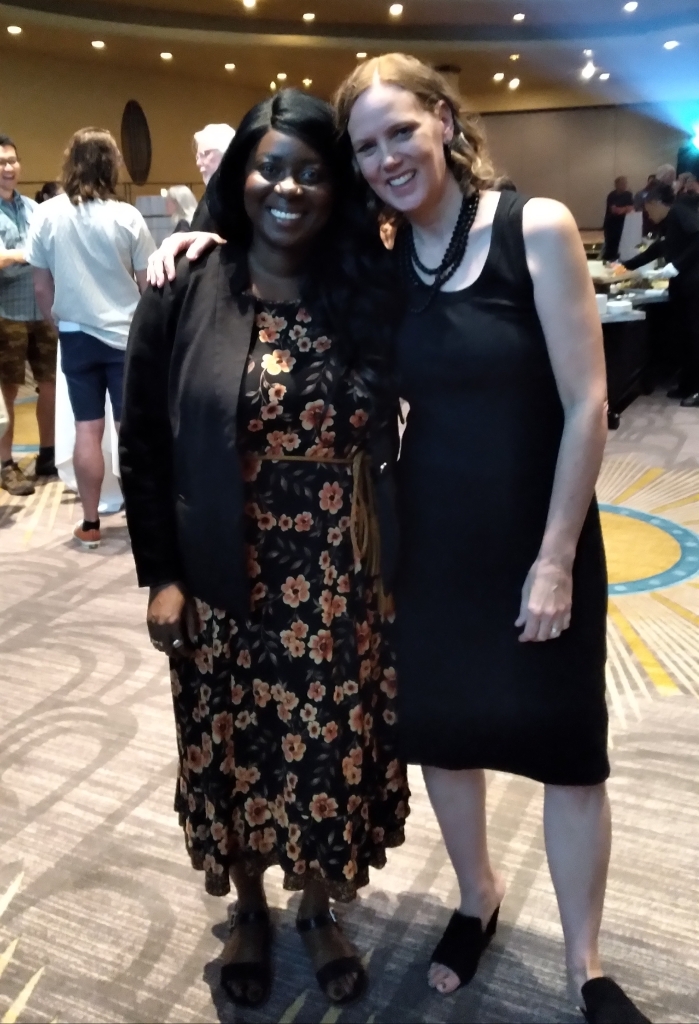
Me with Dr. Yalie Saweda Kamara, Cincinnati & Mercantile Library Poet Laureate
Creating HNA 2023 was a massive undertaking involving innumerable moving parts. It was incredibly gratifying to see so many in the global English-language haiku community come together in my home state for this conference – the first in-person HNA gathering since 2019.
I am extremely grateful to Program Committee members Nicky Gutierrez and Elliot Nicely for their creativity, spirit, and commitment to the project; to local arrangements chairs Patti and Buck Niehoff for their generosity as manifested in so many ways; to HNA Directors Michael Dylan Welch, Garry Gay, Paul Miller, and Deborah Kolodji for their support and guidance; and all conference speakers for their contributions.
My digs at the Hilton Netherland Plaza, Downtown Cincinnati (photo: Jennifer Hambrick)
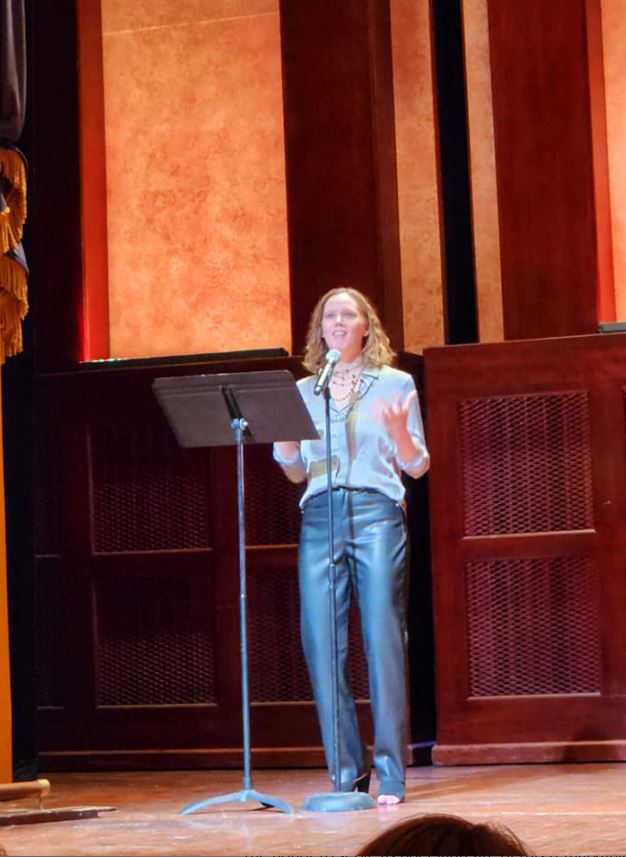
Jennifer Hambrick performing as poet laureate of the 75th-anniversary season of the Chamber Music Columbus concert series, Southern Theatre, Columbus (photo by Antoine Clark)
The 2022-23 concert season recently came to a close and saw the culmination of a major poetry and music commissioning project in which I had the tremendous honor to be involved.
Jennifer Hambrick onstage in the Southern Theatre, Columbus, Nov. 2022 (photo by Antoine Clark)
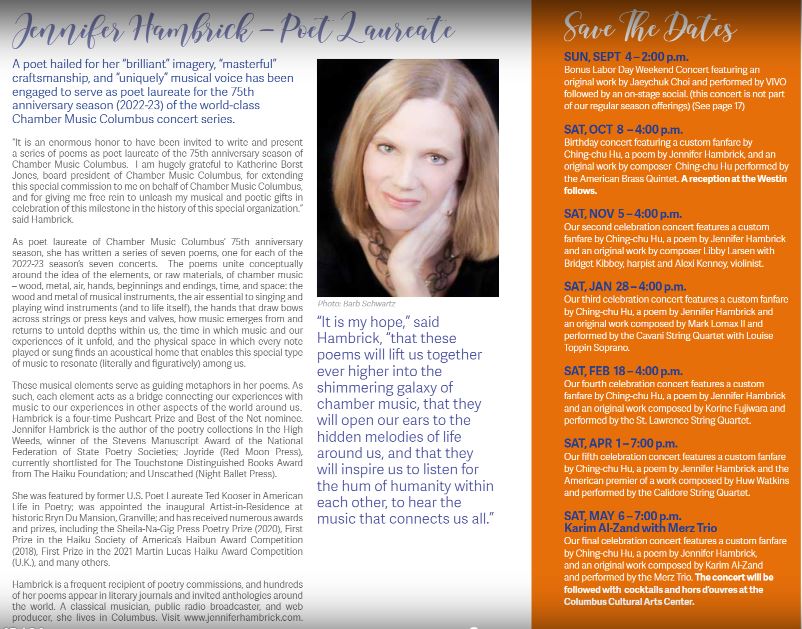
Last season marked the 75th-anniversary season of the Chamber Music Columbus concert series, for I was honored to serve as poet laureate. The anniversary season unfolded in a year-long celebration involving the commissioning and public performances of seven new poems, the world premieres of more than a dozen commissioned musical works by internationally recognized composers, and seven concerts at Columbus’ historic Southern Theatre featuring some of the finest classical chamber music ensembles in the world.
My involvement in the project came about in early 2021, when Katherine Borst Jones, president of the Chamber Music Columbus Board of Trustees and professor of flute at the Ohio State University, invited me to serve as poet laureate for Chamber Music Columbus’ 75th-anniversary season. The laureateship came with a commission to write an original poem for each of the seven concerts on the season and to perform a different one of my poems at the beginning of each concert.
Detail from the Southern Theatre, Columbus (photo by Jennifer Hambrick)
With this commission, Kathy gave me rein to let my imagination soar. As I wrote in my artist’s statement for the project, I crafted all seven of my commissioned poems conceptually around the idea of the elements, or raw materials, of chamber music – wood, metal, air, hands, beginnings and endings, time, and space. These musical elements serve as guiding metaphors in my poems, and each element acts as a bridge connecting our experiences with music to our experiences in other aspects of life and the world around us.
For three quarters of a century, Chamber Music Columbus has brought the finest chamber ensembles in the world to Columbus to perform. The roster of artists who have performed on this series through the decades reads like a Who’s Who of classical music.
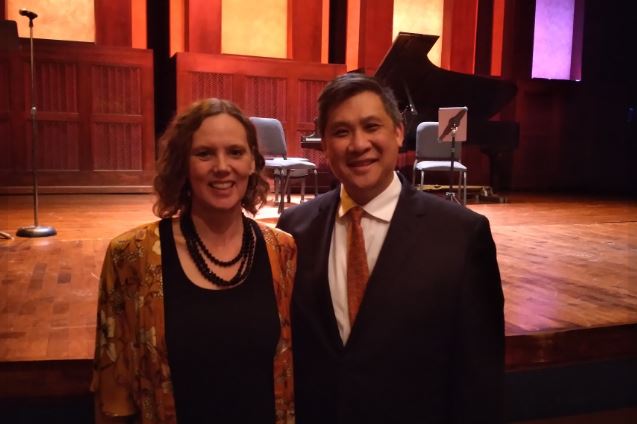
Backstage at the Southern Theatre, before a concert of the Merz Trio, May 2023 (photo by Jennifer Hambrick)
My deep thanks to Kathy Jones and the Chamber Music Columbus Board of Trustees for extending me the honor to serve as poet laureate of this remarkable anniversary season, and congratulations on reaching this milestone.








 jenniferhambrick.com