New Commissioned Poem Premiered in Innovative Musical Collaboration

Jennifer Hambrick performs with the Worthington Chamber Orchestra

I had the distinct honor recently to give return performances as poet and narrator on “Frontiers of Sound,” the Worthington Chamber Orchestra’s first masterworks concert of the 2025-26 concert season.

Jennifer Hambrick, Zoe Johnstone, and Jack Johnstone

To open the concert, I performed my poem “Nightwalk,” commissioned by the Worthington Chamber Orchestra and supported by the Johnstone Fund for New Music. I am most grateful to Antoine Clark, artistic director and music director of the Worthington Chamber Orchestra, for inviting me to collaborate again with him and the orchestra, and to Jack and Zoe Johnstone for their generous support.
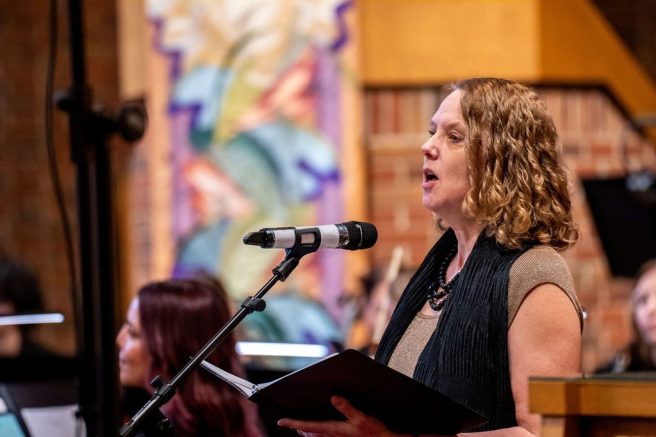
Reading my commissioned poem “Nightwalk” to open the 2025-26 season of the Worthington Chamber Orchestra

The theme of the season’s first concert, “Frontiers of Sound,” took a close look at America’s pioneering spirit and rich history. The program’s poetic and musical offerings reflected this theme in my commissioned poem, and in musical works honoring America’s spirit of innovation. I served as narrator on an orchestration of the Old Worthington Suite by the late Marshall Barnes, former professor of music theory and composition at the Ohio State University School of Music. Composed originally for narrator, flute, clarinet, and piano, and the orchestra, Barnes’ Old Worthington Suite glowed from within in Worthington composer Jacob Reed’s lush orchestration.

Also on the concert were Aaron Copland’s Billy the Kid, along with adventurous musical works by contemporary American composers Aaron Quinn and Jerod Impichchaachaaha’ Tate.
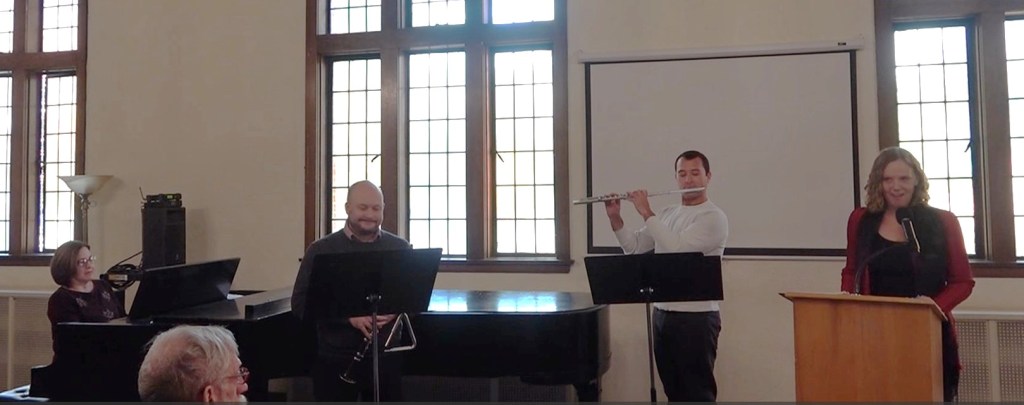
Narrating the original chamber ensemble version of Old Worthington Suite by Marshall Barnes, on the Worthington Chamber Orchestra’s “Frontiers of Sound: Community Connect” event

An accompanying event, Frontiers of Sound: Community Connect, brought the Worthington community together for a performance of the original chamber ensemble version of Barnes’ Old Worthington Suite, in which I performed as narrator. In my WOSU Classical 101 role, I also a panel discussion about historic Worthington’s past and present.

“Frontiers of Sound” marked the first concert of the orchestra’s season-long America250 celebration. The season’s concerts are united under the theme American Crossroads and explore in music the last 250 years of U.S. history and Worthington’s past, present and potential future.

Moderating a panel discussion on the Worthington Chamber Orchestra’s “Frontiers of Sound: Community Connect” event

Poetry Collection ‘a silence or two’ wins Merit Book Award

I am extremely honored and humbled that my most recent book, a silence or two (Red Moon Press), has received a 2025 Merit Book Award from the Haiku Society of America.

According to the Haiku Society of America, the HSA Merit Book Awards “recognize the best haiku and related books published in a given year in the English language.”

a silence or two is a deeply intimate poetic statement. It is raw, visceral. It deals with subject matter at once personal and universal—the body and its failings, trauma, death, loss, identity, and ultimately, the state of fractured wholeness so deep a part of our shared humanity in a broken world. This collection manifests in imagery and narratives that transcend the “objective realism” common to haiku to explore precarious terrain—namely the often unvoiced emotions hidden where flesh, soul, and spirit intersect in the depths of embodiment—for which expected languaging and usual modes of discourse are often insufficient.

Rattle poetry journal editor Tim Green and I discuss a silence or two extensively on Rattlecast.

It is significant that the emotional journey of this collection unfolds in haiku and short prose poems. Haiku tends to be viewed by poets and non-poets as a sort of toss-off genre unworthy of the kind of deep and rigorous study poets and literary scholars routinely devote to other genres. This common misconception and others, however, overlook centuries of profound and profoundly moving poetry in haiku’s original Japanese traditions and in the more recent though vibrant English-language tradition, to which the likes of Richard Wright, Sonia Sanchez, Jack Kerouac, Gary Snyder, and Jane Hirshfield have made significant contributions.

Common misconceptions about haiku also fail to consider that, like all other artistic genres and mediums, haiku invites exploration and the expansion of expressive possibilities. Indeed, haiku is a poetic vehicle uniquely and powerfully suited for conveying extraordinary ways of seeing the world and giving voice to the limitless depths of human emotion.

On every page of a silence or two, I broke the cardinal rules of English-language haiku and pushed other boundaries in ways that some would see as taboo. I am hugely gratified that HSA Merit Book Award competition judges Scott Mason and Patricia Machmiller saw the value of those risks for this book as a work of art and for the genre of haiku in English more broadly.

My deepest thanks and a deep bow to them. Deep thanks also to Jim Kacian and Red Moon Press for publishing this collection.

Featured Poetry Reading on Lit Youngstown Reading Series

Jennifer Hambrick reads on Lit Youngstown’s First Wednesday Readers Series, March 2025

It was an honor to give a featured poetry reading recently on Lit Youngstown’s First Wednesday Readers Series. My deep thanks to the wonderful Karen Schubert, Lit Youngstown founder and executive director, for inviting me to read.

Currently in its tenth year, Lit Youngstown enriches northeastern Ohio with a wide range of literary offerings, including readings, book discussions, writing workshops and camps, and a Fall Literary Festival encompassing writing in all genres. Each month Lit Youngstown’s First Wednesday Reader’s Series hosts readings by established writers in and beyond Ohio.

Learn more about Lit Youngstown on this episode of The Casey Malone Show, Youngstown’s arts and culture TV program, which filmed the segment during my reading on the series:

Poetry can happen anywhere – on the page, on the stage, in libraries, coffee shops, parks – even bowling alleys. Wherever there is a heart that bursts into poetry and ears and/or eyes to take it in, poetry has a home. And where there is poetry, there is the possibility to step out of our comfort zones, approach new ways to experience the world, and grow in empathy.