I had the great honor and pleasure recently to join Tim Green, editor of Rattle poetry journal, as featured guest poet on his livestream, Rattlecast.
Tim and I had a really fun genre-bending conversation about poetry, music, and how music and my work as a classical musician, broadcaster, and cultural journalist informs my work as a poet – and vice versa. We also talked about how my work with music – and my mysterious poetry guardian angel – helped me become a poet in the first place. And I read from my most recent poetry collection, a silence or two.
Our conversation about words and music took place just before the publication of Rattle #85, which features a Tribute to Musicians, in which my poem “My Daddy Was an Appalachian Folksong” appears.
When I write poetry, I aim to make music with words. I spend a good deal of each day thinking and writing about music and considering how the sounds of words and the shapes of phrases and sentences can add up to vibrant writing that dances on the page and rattles in the mind’s ear.
The rhetoric of the physical body here is not strictly metaphorical. Poetry and music offer us powerfully embodied experiences as they work on and in us. We feel certain ways when we experience poems and music, and those feelings are emotional and physical.
I’ve always been fascinated by the sounds and feel of words, and also by how those sounds and feelings have come to mean what they mean. I was the kid who wondered, Gee, why do we call the sky “sky?” How did those particular letters and those particular sounds come to signify the great big blue expanse overhead? And how did “blue” come to signify the color of sky? Why not call it something else? And why call toes “toes?” Why call buttons “buttons?”
Of course, we can trace etymologies and find at least some of the ancestors of the words we speak and write today. But if I were to be teleported back in time and given the opportunity to meet the first person who ever spoke the proto-word that became “sky” or “toe” or “button,” I would ask him or her, What made you think to call this thing by these sounds?
Deep thanks to Tim Green for giving words space to dance and sing in the pages of Rattle, and for inviting me to share some of my words on Rattlecast.
from director Pat van Boeckel’s film inspired by Marjorie Buettner’s haibun “Unremembered,” first screened at the Haiku North America 2023 Haibun Film Festival.
I had the tremendous pleasure recently to serve as program chair for the 2023 Haiku North America (HNA) conference. As a writer of haibun – a Japanese hybrid genre of haiku and prose – and inspired by the wealth of video poems, haiku films, and work in a rich array of other types of work joining poetic writing and visual art, I was inspired to create for HNA the world’s first festival of haibun films.
The HNA Haibun Film Festival took place 29 June 2023 in the beautiful eleventh floor Reading Room of the Mercantile Library of Cincinnati and featured screenings of nine original films inspired by the haibun of five authors. The films selected for the HNA 2023 Haibun Film Festival were posted on Moving Poems shortly after the conclusion of Haiku North America.
My reasons for creating the HNA Haibun Film festival were many. As I remarked in my introduction to the Haibun Film Festival session, “I hypothesized that not only could haibun films realize latent potential of written haibun texts in the filmic dimension, but also that doing so could bring a certain freshness to a literary genre still finding its footing in English and essentially defunct in its native language, Japanese.”
The text of my introduction to the HNA 2023 Haibun Film Festival outlines my rationale for creating the HNA Haibun Film Festival, details the collaborative two-round competitive selection process that led to the final slate of films screened in the festival, and lists the haibun authors and filmmakers whose work was selected for it:
Why haibun films? There’s the obvious ‘why not?’, especially when you consider that haiku films and other types of video poem are nothing new and are vibrant and seemingly limitless pathways for poetry into the stimulating realm of interdisciplinary symbiosis.
And the linking and shifting between a haibun’s haiku and prose – or a haibun’s non-haiku parts – can expand haibun’s narrative and expressive potential into the visual realm and the performative and temporal planes embodied in film.
In creating this, the first-ever haibun film festival, I hypothesized that not only could haibun films realize latent potential of written haibun texts in the filmic dimension, but also that doing so could bring a certain freshness to a literary genre still finding its footing in English and essentially defunct in its native language, Japanese.
The results of this project – which we’ll view this hour – will, I hope, inspire those who have not written haibun to explore this genre’s creative possibilities as seriously as they might explore other genres, like haiku, and to create haibun films as solo or collaborative enterprises.
The short haibun films you’ll see were catalyzed and selected though a multi-stage, internationally competitive process. Last year, Haiku North America sent out a call for submissions of unpublished haibun. We received 229 submissions in response. I asked Jim Kacian [founder and president of The Haiku Foundation and founder and owner of Red Moon Press] to serve with me as haibun co-screener, in light of his deep roots in the haibun soil, and also in light of his work in haiku films – thank you, Jim. A moment here also to thank Paul Miller [HNA director and editor of Modern Haiku] for anonymizing the submissions before sending the haibun texts to Jim and me, and also for communicating directly with the writers who submitted haibun.
In a “double-blind” screening, Jim and I first narrowed down the 229 submissions to around 40-50 haibun. We eventually selected ten haibun for their merits as pieces of writing in this genre – interesting stories told in vivid prose and well-crafted haiku. I was also interested in feeling a certain space where the actual words on the page left off and potential visual responses to the texts – not merely visual renderings or reenactments of them – might pick up.
The titles and contest entry numbers of the ten selected films were sent to Dave Bonta, founder of the video poem website Moving Poems and author of the haibun collection Failed State (Via Negativa Books).
I’d like now to acknowledge the authors of the ten haibun that Jim Kacian and I selected to send to Dave and Moving Poems, in alphabetical order by author last name:
The Gone Missing – haibun by Joseph Aversano, five different films by: Beate Gördes, Janet Lees, Peter Johnston, EnD, and Marilyn McCabe Circuition – haibun by Mona Bedi Unremembered – haibun by Marjorie Buettner, film by Pat van Boeckel Of Demons and Angels – haibun by Penny Harter The Chase – haibun by Bob Lucky The Longest Journey – haibun by Bob Lucky, film by Pete Johnston Table for One – haibun by Carol Ann Palomba, film by Matt Mullins *Film Awarded Best of Show Hypnic Jerk – haibun by Alan Peat, film by Jack Cochran, Pamela Falkenberg The Layout – haibun by Beth Skala Haven – haibun by Laurie Wilcox-Meyer
Dave posted a call for film submissions on FilmFreeway and formed a committee to screen the film entries. I’d like to thank Dave for organizing the film part of this project and for serving with the award-winning poets and filmmakers Jane Glennie and James Brush to judge the films that were submitted.
Dave, Jane, and James selected nine haibun films, which Dave will screen for us today.
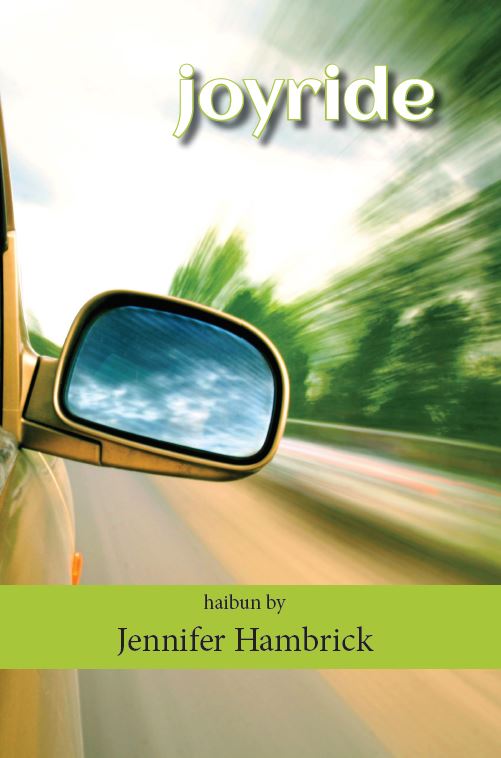
It’s been a rough year. Couldn’t we all use a joyride?
I am delighted to announce the arrival of my most recent book, Joyride, from Red Moon Press.
Hailed as “a triumph” and “a beautifully written book, fizzing with marvelous imagery, energy, joie de vivre,” Joyride: A Haibun Road Trip is a lively mashup of flash fiction, memoir, free verse poetry, and haiku – an expansive take on the Japanese hybrid genre of haibun – that unfolds in offbeat episodes from the road of life.
You’ll meet a colorful cast of characters, and motoring through the collection are the automobiles – food trucks, used cars, moving vans, and others – that take us where we want to go and bring us home again.
Read advance praise for Joyride and purchase your very own copy here.
I am extremely honored and humbled to have won First Place in the Haiku Society of America’s 2018 Haibun Awards Competition with my haibun “That Summer.”
The genre of haibun consists of the juxtaposition of prose and haiku in ways that allow the two genres to resonate uniquely with each other, creating multiple layers of meaning. Here is “A Brief History of English-Language Haibun” by Jim Kacian, founder and board chairperson of The Haiku Foundation and one of the leading exponents of English-language haiku and related genres. This essay was compiled from Kacian’s introductions, and with Kacian’s permission, by Ray Rasmussen, the present editor of the major haibun journal Haibun Today.
“That Summer” is published on the Haiku Society of America’s website. My haibun will also be published in the Haiku Society of America’s journal, Frogpond, one of the finest publications of English-language haiku and related genres. [Update, 2-29-20: “That Summer” was published on the Haiku Society of America’s website and in Frogpond.]
Sincere thanks to competition judge John Stevenson, and hearty congratulations to my fellow poets who also won awards in this contest.
The son of the pioneering American haikuist George Klacsanzky, Nicholas Klacsanzky follows in his father’s footsteps with his own esteemed poetry in the Japanese short forms and through Haiku Commentary, where he uncovers the inner workings of present-day examples of what he calls “perhaps the smallest style of poetry.”
Of my ‘deployment’ haiku Klacsansky writes, “This haiku has a lot of energy to it. It has an immediacy and freshness that most haiku do not have.” His insights into the “energy” of the em dash, the “immediacy” of not naming the type of tree that so quickly drops its leaves in the poem, and the “melancholy” and “stark” effects of the vowels are fascinating to me as the poet.
But I am most struck by what Klacsanzky has to say about the last line of the poem: “The pacing of the haiku is powerful, especially with how the last line comes. Not only is the punctuation used for a significant emotional end, but also the last line (without tricks) is palpable and alarming.”
Of course, I planned none of these effects, per se. But I’m glad the poem has them, and that Klacsanzky’s extremely thoughtful commentary has laid them bare. And I’m glad the poem is, in its own way, “alarming.” The finality of the end of a single human life, much less of the legions who perish at war, should stop us cold. The tree in my poem will likely grow new leaves come spring. The souls lost in battle are gone forever.
If a poet writes a poem and no one reads it, does the poem have meaning? This question is one for the philosophers. As a poet, though, I find I reassuring that a reader with Nicholas Klacsanzky’s deep insights into poetry is so committed to sharing them respectfully and unpretentiously for everyone to experience. Klacsanzky’s Haiku Commentary helps make the world of English-language haiku one of wonder and discovery for all.
 It’s been a rough year. Couldn’t we all use a joyride?

 jenniferhambrick.com