Poetry Collection ‘a silence or two’ wins Merit Book Award

I am extremely honored and humbled that my most recent book, a silence or two (Red Moon Press), has received a 2025 Merit Book Award from the Haiku Society of America.

According to the Haiku Society of America, the HSA Merit Book Awards “recognize the best haiku and related books published in a given year in the English language.”

a silence or two is a deeply intimate poetic statement. It is raw, visceral. It deals with subject matter at once personal and universal—the body and it failings, trauma, death, loss, identity, and ultimately, the state of fractured wholeness so deep a part of our shared humanity in a broken world. This collection manifests in imagery and narratives that transcend the “objective realism” common to haiku to explore precarious terrain—namely the often unvoiced emotions hidden where flesh, soul, and spirit intersect in the depths of embodiment—for which expected languaging and usual modes of discourse are often insufficient.

Rattle poetry journal editor Tim Green and I discuss a silence or two extensively on Rattlecast.

It is significant that the emotional journey of this collection unfolds in haiku and short prose poems. Haiku tends to be viewed by poets and non-poets as a sort of toss-off genre unworthy of the kind of deep and rigorous study poets and literary scholars routinely devote to other genres. This common misconception and others, however, overlook centuries of profound and profoundly moving poetry in haiku’s original Japanese traditions and in the more recent though vibrant English-language tradition, to which the likes of Richard Wright, Sonia Sanchez, Jack Kerouac, Gary Snyder, and Jane Hirshfield have made significant contributions.

Common misconceptions about haiku also fail to consider that, like all other artistic genres and mediums, haiku invites exploration and the expansion of expressive possibilities. Indeed, haiku is a poetic vehicle uniquely and powerfully suited for conveying extraordinary ways of seeing the world and giving voice to the limitless depths of human emotion.

On every page of a silence or two, I broke the cardinal rules of English-language haiku and pushed other boundaries in ways that some would see as taboo. I am hugely gratified that HSA Merit Book Award competition judges Scott Mason and Patricia Machmiller saw the value of those risks for this book as a work of art and for the genre of haiku in English more broadly.

My deepest thanks and a deep bow to them. Deep thanks also to Jim Kacian and Red Moon Press for publishing this collection.

A Conversation with Rattle Poetry Journal Editor Tim Green on Rattlecast

I had the great honor and pleasure recently to join Tim Green, editor of Rattle poetry journal, as featured guest poet on his livestream, Rattlecast.

Tim and I had a really fun genre-bending conversation about poetry, music, and how music and my work as a classical musician, broadcaster, and cultural journalist informs my work as a poet – and vice versa. We also talked about how my work with music – and my mysterious poetry guardian angel – helped me become a poet in the first place. And I read from my most recent poetry collection, a silence or two.

Our conversation about words and music took place just before the publication of Rattle #85, which features a Tribute to Musicians, in which my poem “My Daddy Was an Appalachian Folksong” appears.

When I write poetry, I aim to make music with words. I spend a good deal of each day thinking and writing about music and considering how the sounds of words and the shapes of phrases and sentences can add up to vibrant writing that dances on the page and rattles in the mind’s ear.

The rhetoric of the physical body here is not strictly metaphorical. Poetry and music offer us powerfully embodied experiences as they work on and in us. We feel certain ways when we experience poems and music, and those feelings are emotional and physical.

I’ve always been fascinated by the sounds and feel of words, and also by how those sounds and feelings have come to mean what they mean. I was the kid who wondered, Gee, why do we call the sky “sky?” How did those particular letters and those particular sounds come to signify the great big blue expanse overhead? And how did “blue” come to signify the color of sky? Why not call it something else? And why call toes “toes?” Why call buttons “buttons?”

Of course, we can trace etymologies and find at least some of the ancestors of the words we speak and write today. But if I were to be teleported back in time and given the opportunity to meet the first person who ever spoke the proto-word that became “sky” or “toe” or “button,” I would ask him or her, What made you think to call this thing by these sounds?

Deep thanks to Tim Green for giving words space to dance and sing in the pages of Rattle, and for inviting me to share some of my words on Rattlecast.

Announcing the arrival of a silence or two

I am extremely excited to announce the publication of my most recent poetry collection, a silence or two, by Red Moon Press.

Hailed as “a stunning collection … destined to become a haiku classic,” a silence or two mines the territory of loss, healing, transformation, and joy in haiku and short prose poems that take the haiku form and narrativity between genres into new expressive ground.

Read advance praise for a silence or two from Cherie Hunter Day, Dr. Richard Gilbert, and Michelle Tennison and check out my other books on the Books page. You can also purchase copies from there (click on the book cover images) and through the Order page.

My deepest gratitude to Jim Kacian, founder and president of The Haiku Foundation and publisher at Red Moon Press, for guiding this collection into the world with such patience and care.

Inaugural Heliosparrow Frontier Awards Honor Cutting-Edge Poetry

Photo: via Wikimedia Commons Lisa Mastino, CC BY-SA 4.0

I’m humbled to have received four First Prize honors, three Honorable Mentions, and a Special Award for haiku recently in the inaugural Heliosparrow Haiku Frontier Awards.

All of the awarded poems and the judges’ fascinating and extremely rich commentary on them are published in Helioparrow Poetry Journal and in the flipbook at this link.

The awards were created by Dr. Richard Gilbert, professor emeritus of English, Kumamoto University, and one of the world’s leading theorists and critics of contemporary English-language haiku, “to present and praise leading-edge poems and poets illuminating inspiring directions in haiku poetics.”

All of the poems under consideration for the Frontier Awards were published in Heliosparrow Poetry Journal – the world’s leading publication of avant-garde English-language haiku and poems in related genres – which Gilbert founded and edits.

Gilbert, Heliosparrow co-editor Clayton Beach, and poet Michelle Tennison served as judges for the haiku, alterku (poems that expand the haiku form), sequence/collaborative poem, and short poem categories in the contest. I was also honored to judge the haibun category, and to join Gilbert, Beach, and Tennison in judging the alterku and sequence/collaborative poem categories, in which my own work was not in the running.

Far from traditional haiku rooted in the seasons of the non-human natural world, the poems recognized in the inaugural Heliosparrow Haiku Frontier Awards reinterpret the traditional haiku form through daring language, startling imagery, bold disposition on the page, and challenging subject matter and psychological nuance.

To read these poems is to look into the future of English-language haiku.

Poem Featured in Ted Kooser’s ‘American Life in Poetry’

Photo: Stanley Zimny/Creative Commons BY-NC 2.0

I am honored and humbled to see one of my poems featured in former U.S. Poet Laureate Ted Kooser’s newspaper and online column, American Life in Poetry.

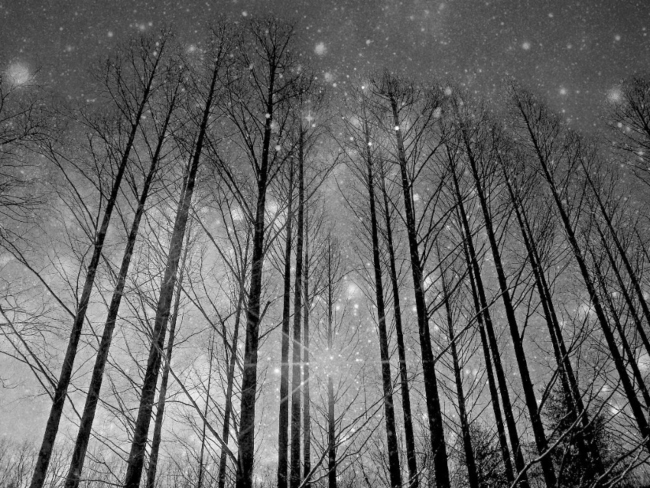
“Starry night” came to me in a flash and fully formed. And if the poem is “about” anything, it is this: the safe embrace of oaks and maples and beech trees scaffolding their branches into a haven from the world beyond.

And up above leafless limbs, stars spattered across the heavens like duff dropped on the forest floor, the vastness of the universe expanding me with wonder, and the present living moment holding hands with millions of years ago in the graceful give of acorns underfoot and tiny points of starlight overhead.

The poem was first published in Modern Haiku.  My sincere thanks to editor Paul Miller for publishing the poem and to Ted Kooser for republishing it with his thoughtful commentary.

First Artist-in-Residence At Historic Bryn Du Mansion

mansion_777
Bryn Du Mansion, Granville, Ohio

I am extremely honored to have been appointed the inaugural Artist-in-Residence at historic Bryn Du Mansion, in Granville, Ohio.

Home of Denison University, Granville is a beautiful town full of cultural and historical riches. I am excited to be able to live on the beautiful grounds of Bryn Du Mansion during my term of residency, October – November 2019.

The role of Artist-in-Residence at Bryn Du Mansion emphasizes community engagement through the arts. To that end, this fall I will present a series of public events that will feature poetry alone and in combination with music and visual art.

Here’s the lineup:

Poetry reading and community open mic at Bryn Du Mansion

Words and Musica performance of new works by Denison student composers setting my poetry. Performers include Denison University music students and the world-renowned new music string quartet, ETHEL, Denison University’s Quartet-in-Residence. 

Jazz Haiku @ Bryn Du – a cabaret-style event featuring a professional jazz trio’s improvisations in response to my experimental haiku, alongside an exhibition of my urban photographic haiga (haiku + photography)

Poetry writing workshops for senior citizens and for intermediate school students.

It is an extraordinary opportunity to serve the Granville community as Bryn Du Mansion’s first Artist-in-Residence. I am deeply humbled to have been selected for this role, and I am excited to make Granville my home this fall to get to know my new neighbors throughout the community.

Stone Poetry: Haigaonline Publishes Portfolio of Haiga Inspired by Earth and Rock

Jennifer Hambrick - waning autumn WITH SIGNATURE
“waning summer” by Jennifer Hambrick. First published in Haigaonline, Vol. 19-2, Autumn 2018. © 2018 Jennifer Hambrick. All rights reserved.

I am grateful to have another mini portfolio of my haiga published in the most recent issue of the journal Haigaonline. This issue. “Viewing Stones,” features haiga inspired by and depicting rocks, stones and earth.

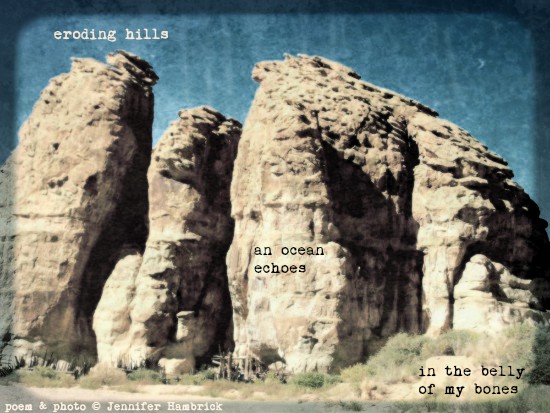
All of the photographs in my haiga mini portfolio, “Ancient Days,” were shot in New Mexico, where earth is poetry in its own right. The haiga above, “waning summer,” shows a wall on a New Mexico pueblo crumbling “back to the earth.” The haiga below, “eroding hills,” depicts the skeletons of mountains that, eons ago, had been submerged in a vast inland sea, and that now stand, eroded and ghostlike, in the New Mexico desert.

Jennifer Hambrick - eroding hills WITH SIGNATURE
“eroding hills” by Jennifer Hambrick. First published in Haigaonline, Vol. 19-2, Autumn 2018. © 2018 Jennifer Hambrick. All rights reserved.

In “dust devil,” an ant hill inspires a bit of word play.

Jennifer Hambrick - dust devil 72 dpi
“dust devil” by Jennifer Hambrick. First published in Haigaonline, Vol. 19-2, Autumn 2018. © 2018 Jennifer Hambrick. All rights reserved.

View the remaining haiga in my portfolio here.

My sincere thanks to Haigaonline editor Linda Papanicolaou for tirelessly catalyzing new work in the genre of haiga, and for again publishing my work in her journal.

Haibun Wins First Place in Haiku Society of America Competition

JD Hancock - Down with Rainbows
Photo: JD Hancock/Creative Commons/Flickr

I am extremely honored and humbled to have won First Place in the Haiku Society of America’s 2018 Haibun Awards Competition with my haibun “That Summer.”

The genre of haibun consists of the juxtaposition of prose and haiku in ways that allow the two genres to resonate uniquely with each other, creating multiple layers of meaning. Here is “A Brief History of English-Language Haibun” by Jim Kacian, founder and board chairperson of The Haiku Foundation and one of the leading exponents of English-language haiku and related genres. This essay was compiled from Kacian’s introductions, and with Kacian’s permission, by Ray Rasmussen, the present editor of the major haibun journal Haibun Today.

“That Summer” is published on the Haiku Society of America’s website. My haibun will also be published in the Haiku Society of America’s journal, Frogpond, one of the finest publications of English-language haiku and related genres. [Update, 2-29-20: “That Summer” was published on the Haiku Society of America’s website and in Frogpond.]

Sincere thanks to competition judge John Stevenson, and hearty congratulations to my fellow poets who also won awards in this contest.

Portfolio of Haiga Inspired by Trees Featured in Haigaonline

Hambrick - you would never have guessed 72 dpi
Haiga “you would never have guessed” by Jennifer Hambrick. Poem and photo © 2017 Jennifer Hambrick. All rights reserved. First published in Haigaonline, Vol. 19, No. 1 (Spring 2018).

Go create haiga – artworks that join visual image with haiku – inspired by trees.

That was the essentially challenge the wonderful journal Haigaonline issued last fall to all practitioners of the ancient genre of haiga. And is there anyone who wouldn’t want to spend time gazing at, photographing, and writing about trees?

No, there is not.

I am most grateful to Haigaonline editor Linda Papanicolaou for showcasing four of my tree-inspired haiga in a featured portfolio of my work in the journal’s most recent issue, Vol. 19, No. 1, published spring 2018.

Here is Papanicolaou’s commentary about my haiga in this featured portfolio, and below are the haiga themselves:

Each of the tree haiga in the present portfolio approaches the interaction of text and image differently. In the first, the image of a maple tree in fall colors mirrors line 3 of the poem. In the second, there’s a wider shift as the deep red, not yet fallen leaves of the image serve as visual metaphor for the text. In the third, the image of the tree is a structural support for a concrete poem, bot linked by the revelation of line 3. The text of the fourth is dependent on the image and may not work as a stand-alone poem, but it has the bite that I’ve come to know as characteristic of Jennifer’s senryu haiga. It’s a commentary on the disposability of trees in our consumerist culture.

About eight years ago our beautiful ash tree, pictured in the haiga above (“you would never have guessed”), was diagnosed with the emerald ash borer. I wept for a week as we considered our options, but destroying and removing the tree was simply not one of them. So, we signed up for tree health care, contracting with a tree service to give the ash biennial treatments of a substance that drives away the borer. The tree is still with us and is still glorious, though its thin canopy and brittle branches remain telltale signs of its illness.

I took this photo standing under the ash tree and looking up into the canopy, which was thinning as much from autumn leaf droppage as from the borer. The haiku our fragile tree inspired comments on the ephemerality of all life and our common human delusion that all there is to any life – tree, human, or otherwise – is what meets the eye.

Hambrick - the honeyed glow 72 dpi
Haiga “the honeyed glow” by Jennifer Hambrick. Poem and photo © 2017 Jennifer Hambrick. All rights reserved. First published in Haigaonline, Vol. 19, No. 1 (Spring 2018).

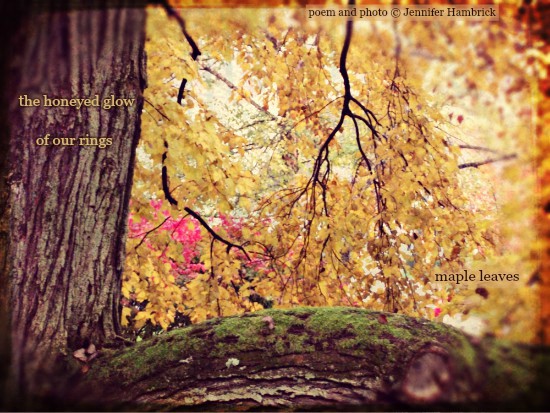
One day last fall, the sun was pouring through the yellow leaves of our maple tree that, from the second story of our home, I felt absolutely wrapped in a warm, golden glow. The image in this haiga relates something of that glow, and whatever emotional warmth the camera could not capture, the haiku, hopefully, helps to convey.

Hambrick - autumn sun 72 dpi
Haiga “autumn sun” by Jennifer Hambrick. Poem and photo © 2017 Jennifer Hambrick and Siwoo Kim. All rights reserved. First published in Haigaonline, Vol. 19, No. 1 (Spring 2018).

My friend the violinist Siwoo Kim took this photograph while traveling in South Korea and posted an unedited version of it on Facebook. When I saw the picture, the contrast between the vibrancy of the red leaves and the autumnal feel of the setting sun took my breath away. Siwoo gave me his blessing to turn his photo into a haiga, so I edited the image, bringing out more of the drama of the lighting and adding a border and the text of my poem, which the image inspired.

Hambrick - recycling day
Haiga “recycling day” by Jennifer Hambrick. Poem and photo © 2017 Jennifer Hambrick. All rights reserved. First published in Haigaonline, Vol. 19, No. 1 (Spring 2018).

On the day after Christmas 2017, a sadly large number of pine trees were lying at curbs all around our neighborhood. They had been put out just in time for the recycling collectors.

Congratulations to my fellow haiga artists whose work also appears in this issue of Haigonline.

International Women’s Haiku Festival: Haiku by Marion Clarke

Greg Lobinski - clock
Photo: Greg Lobinski/Creative Commons/Flickr

Concluding the 2018 international Women’s Haiku Festival is a haiku by Northern Irish poet Marion Clarke.

ticking clock . . .
so many things to tell
my daughter

There is the ticking biological clock that, along with other factors, dictates the reproductive fate of every woman. But there is also the ceaseless march of time more generally, the grandfather clock that ticks in tandem with the heartbeat of all humankind. Both clocks are ticking away in this haiku, which points to the special kind of relationship many mothers and daughters share, while reminding us how little time we all have. So many things to tell, more than a lifetime, more than two lifetimes, can hold.

Marion Clarke is from the east coast of Northern Ireland, about which she writes,“The scenery where I live is amazing as the sea, mountains and forest are all within walking distance, so I feel I was destined to become a haiku poet! My poems are inspired by those I’ve loved and lost.”