Poetry Collection ‘a silence or two’ wins Merit Book Award

I am extremely honored and humbled that my most recent book, a silence or two (Red Moon Press), has received a 2025 Merit Book Award from the Haiku Society of America.

According to the Haiku Society of America, the HSA Merit Book Awards “recognize the best haiku and related books published in a given year in the English language.”

a silence or two is a deeply intimate poetic statement. It is raw, visceral. It deals with subject matter at once personal and universal—the body and it failings, trauma, death, loss, identity, and ultimately, the state of fractured wholeness so deep a part of our shared humanity in a broken world. This collection manifests in imagery and narratives that transcend the “objective realism” common to haiku to explore precarious terrain—namely the often unvoiced emotions hidden where flesh, soul, and spirit intersect in the depths of embodiment—for which expected languaging and usual modes of discourse are often insufficient.

Rattle poetry journal editor Tim Green and I discuss a silence or two extensively on Rattlecast.

It is significant that the emotional journey of this collection unfolds in haiku and short prose poems. Haiku tends to be viewed by poets and non-poets as a sort of toss-off genre unworthy of the kind of deep and rigorous study poets and literary scholars routinely devote to other genres. This common misconception and others, however, overlook centuries of profound and profoundly moving poetry in haiku’s original Japanese traditions and in the more recent though vibrant English-language tradition, to which the likes of Richard Wright, Sonia Sanchez, Jack Kerouac, Gary Snyder, and Jane Hirshfield have made significant contributions.

Common misconceptions about haiku also fail to consider that, like all other artistic genres and mediums, haiku invites exploration and the expansion of expressive possibilities. Indeed, haiku is a poetic vehicle uniquely and powerfully suited for conveying extraordinary ways of seeing the world and giving voice to the limitless depths of human emotion.

On every page of a silence or two, I broke the cardinal rules of English-language haiku and pushed other boundaries in ways that some would see as taboo. I am hugely gratified that HSA Merit Book Award competition judges Scott Mason and Patricia Machmiller saw the value of those risks for this book as a work of art and for the genre of haiku in English more broadly.

My deepest thanks and a deep bow to them. Deep thanks also to Jim Kacian and Red Moon Press for publishing this collection.

Inaugural Heliosparrow Frontier Awards Honor Cutting-Edge Poetry

Photo: via Wikimedia Commons Lisa Mastino, CC BY-SA 4.0

I’m humbled to have received four First Prize honors, three Honorable Mentions, and a Special Award for haiku recently in the inaugural Heliosparrow Haiku Frontier Awards.

All of the awarded poems and the judges’ fascinating and extremely rich commentary on them are published in Helioparrow Poetry Journal and in the flipbook at this link.

The awards were created by Dr. Richard Gilbert, professor emeritus of English, Kumamoto University, and one of the world’s leading theorists and critics of contemporary English-language haiku, “to present and praise leading-edge poems and poets illuminating inspiring directions in haiku poetics.”

All of the poems under consideration for the Frontier Awards were published in Heliosparrow Poetry Journal – the world’s leading publication of avant-garde English-language haiku and poems in related genres – which Gilbert founded and edits.

Gilbert, Heliosparrow co-editor Clayton Beach, and poet Michelle Tennison served as judges for the haiku, alterku (poems that expand the haiku form), sequence/collaborative poem, and short poem categories in the contest. I was also honored to judge the haibun category, and to join Gilbert, Beach, and Tennison in judging the alterku and sequence/collaborative poem categories, in which my own work was not in the running.

Far from traditional haiku rooted in the seasons of the non-human natural world, the poems recognized in the inaugural Heliosparrow Haiku Frontier Awards reinterpret the traditional haiku form through daring language, startling imagery, bold disposition on the page, and challenging subject matter and psychological nuance.

To read these poems is to look into the future of English-language haiku.

New Book ‘Fizzes’ With Offbeat Stories

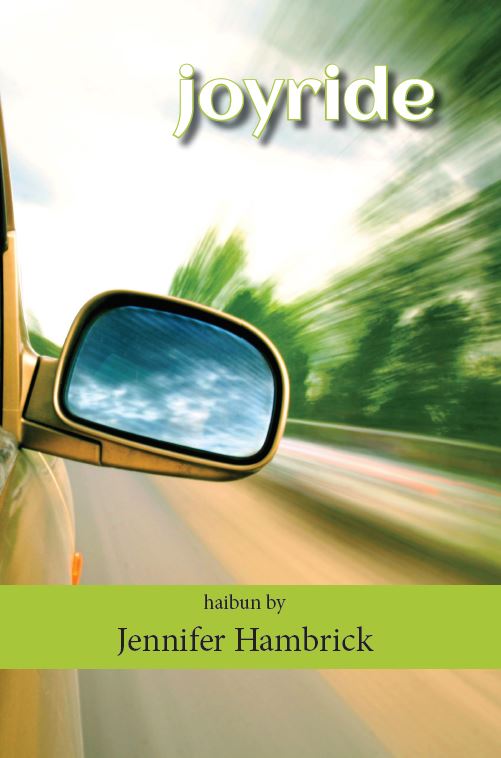
for-website-joyride-cover-3It’s been a rough year.  Couldn’t we all use a joyride?
I am delighted to announce the arrival of my most recent book, Joyride, from Red Moon Press.

Hailed as “a triumph” and “a beautifully written book, fizzing with marvelous imagery, energy, joie de vivre,” Joyride: A Haibun Road Trip is a lively mashup of flash fiction, memoir, free verse poetry, and haiku – an expansive take on the Japanese hybrid genre of haibun – that unfolds in offbeat episodes from the road of life.

You’ll meet a colorful cast of characters, and motoring through the collection are the automobiles – food trucks, used cars, moving vans, and others – that take us where we want to go and bring us home again. 

Read advance praise for Joyride and purchase your very own copy here.

Stone Poetry: Haigaonline Publishes Portfolio of Haiga Inspired by Earth and Rock

Jennifer Hambrick - waning autumn WITH SIGNATURE
“waning summer” by Jennifer Hambrick. First published in Haigaonline, Vol. 19-2, Autumn 2018. © 2018 Jennifer Hambrick. All rights reserved.

I am grateful to have another mini portfolio of my haiga published in the most recent issue of the journal Haigaonline. This issue. “Viewing Stones,” features haiga inspired by and depicting rocks, stones and earth.

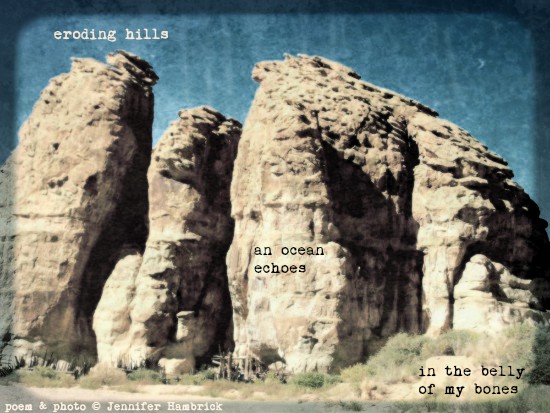
All of the photographs in my haiga mini portfolio, “Ancient Days,” were shot in New Mexico, where earth is poetry in its own right. The haiga above, “waning summer,” shows a wall on a New Mexico pueblo crumbling “back to the earth.” The haiga below, “eroding hills,” depicts the skeletons of mountains that, eons ago, had been submerged in a vast inland sea, and that now stand, eroded and ghostlike, in the New Mexico desert.

Jennifer Hambrick - eroding hills WITH SIGNATURE
“eroding hills” by Jennifer Hambrick. First published in Haigaonline, Vol. 19-2, Autumn 2018. © 2018 Jennifer Hambrick. All rights reserved.

In “dust devil,” an ant hill inspires a bit of word play.

Jennifer Hambrick - dust devil 72 dpi
“dust devil” by Jennifer Hambrick. First published in Haigaonline, Vol. 19-2, Autumn 2018. © 2018 Jennifer Hambrick. All rights reserved.

View the remaining haiga in my portfolio here.

My sincere thanks to Haigaonline editor Linda Papanicolaou for tirelessly catalyzing new work in the genre of haiga, and for again publishing my work in her journal.

Haibun Wins First Place in Haiku Society of America Competition

JD Hancock - Down with Rainbows
Photo: JD Hancock/Creative Commons/Flickr

I am extremely honored and humbled to have won First Place in the Haiku Society of America’s 2018 Haibun Awards Competition with my haibun “That Summer.”

The genre of haibun consists of the juxtaposition of prose and haiku in ways that allow the two genres to resonate uniquely with each other, creating multiple layers of meaning. Here is “A Brief History of English-Language Haibun” by Jim Kacian, founder and board chairperson of The Haiku Foundation and one of the leading exponents of English-language haiku and related genres. This essay was compiled from Kacian’s introductions, and with Kacian’s permission, by Ray Rasmussen, the present editor of the major haibun journal Haibun Today.

“That Summer” is published on the Haiku Society of America’s website. My haibun will also be published in the Haiku Society of America’s journal, Frogpond, one of the finest publications of English-language haiku and related genres. [Update, 2-29-20: “That Summer” was published on the Haiku Society of America’s website and in Frogpond.]

Sincere thanks to competition judge John Stevenson, and hearty congratulations to my fellow poets who also won awards in this contest.

International Women’s Haiku Festival: Haiku by Marion Clarke

Greg Lobinski - clock
Photo: Greg Lobinski/Creative Commons/Flickr

Concluding the 2018 international Women’s Haiku Festival is a haiku by Northern Irish poet Marion Clarke.

ticking clock . . .
so many things to tell
my daughter

There is the ticking biological clock that, along with other factors, dictates the reproductive fate of every woman. But there is also the ceaseless march of time more generally, the grandfather clock that ticks in tandem with the heartbeat of all humankind. Both clocks are ticking away in this haiku, which points to the special kind of relationship many mothers and daughters share, while reminding us how little time we all have. So many things to tell, more than a lifetime, more than two lifetimes, can hold.

Marion Clarke is from the east coast of Northern Ireland, about which she writes,“The scenery where I live is amazing as the sea, mountains and forest are all within walking distance, so I feel I was destined to become a haiku poet! My poems are inspired by those I’ve loved and lost.”

International Women’s Haiku Festival: Haiku by Michelle Hyatt

Chris Isherwood - Near
Photo: Chris Isherwood/Creative Commons/Flickr

Demons inner and outer haunt a haiku by Canadian poet Michelle Hyatt.

so much makeup
hiding her face
dark side of the moon

Is this a poem about a woman so desperate for beauty that she goes overboard trying to paint it on, or about a woman who is hiding evidence of physical violence beneath mounds of cream and powder? Each interpretation speaks to a different type of darkness – the inner darkness that cannot let her see and accept her own beauty, or the darkness of abuse. And all of these layers of darkness are set in contrast to the chalky white light of that serene goddess, the ever-watching moon.

Michelle Hyatt enjoys wandering anywhere that takes her to trees, mountains, water, and moonlit forests. It is in these places where her heart feels most at home and finds creative inspiration, which sometimes develops into tiny poems. Some of her other work can be found in Yanty’s Butterfly – Haiku Nook: An Anthology. Michelle lives in Canada.

International Women’s Haiku Festival: Haiku by Marta Chociłowska

stanze - Spring
Photo: stanze/Creative Commons/Flickr

Polish poet Marta Chociłowska paints a picture of the happy hustle and bustle of a market flower stand in a delightful haiku.

shopping list
a woman at the market
sells catkins

Imagine a bustling market with a stall where a woman, Eliza Doolittle-like, sells fresh-cut flowers and bundles of long, beautiful willow branches dotted up and down with soft, fuzzy catkins. Isn’t that just like your shopping list? Long and bulleted with comfort-food coziness? This clever haiku is bursting at the seams with the kind of upbeat hustle and bustle that makes you feel fully alive.

Marta Chocilowska, of Warsaw, Poland, is a fan of cats and poetry, co-author of Polish and foreign haiku anthologies, winner of Polish and international haiku contests, and a juror in Polish and foreign haiku contests. She has publications in many international haiku and haiga magazines. She is a founding Member of the Polish Haiku Association.

International Women’s Haiku Festival: Two Haiku by David He

yowlong - Chestnut Hill Reservoir at Dusk
Photo: yowlong/Creative Commons/Flickr

Poet David He gives voice to a young girl’s sweet song and an older woman’s early dusk in two beautiful haiku.

a green leaf
between the girl’s lips
her sweet song

I envision a little girl holding a green leaf between her lips and humming a happy tune – maybe that of a nursery song, or maybe a tune she’s making up on the spot. This poem a tight shot on a moment of complete innocence. Maybe the girl doesn’t know anyone sees her with the leaf between her lips or hears her “sweet song.” Or maybe she does know and doesn’t even think to care. The poet’s language is as simple and unburdened as the haiku moment it captures.

***

Mum’s story
in her grey hair…
early dusk

The vivid image of a woman’s grey hair tells only part of the woman’s story. But the “early dusk” in the poem’s third line says it all. This grey-haired woman isn’t exactly old; her hair makes her look older than she is, and – doubly tragic – this in the face of an “early dusk.”

David He has been working as an advanced English teacher for 35 years in a high school. He has had twenty English-language short stories published in anthologies. His haiku have been published in
Acorn, The Heron’s Nest, Presence, Rocket bottles, Frogpond, One Hundred Gourds, Shamrock, First Literary Review-East, Modern Haiku, Frozen Butterfly, and elsewhere. He has also had tanka published in Skylark, Ribbons, and Cattails.  

International Women’s Haiku Festival: Two Poems by Valorie Broadhurst Woerdehoff

Chris Staley
Photo: Chris Staley/Creative Commons/Flickr

Mama’s new pair of shoes and Daddy’s obituary star in two poems by U.S. poet Valorie Broadhurst Woerdehoff.

new stilettos
she announces
her divorce

And there she is with her new stilettos, with her new-found independence, with all the concomitant fears and regrets and scars and, unless she’s some kind of stiletto-wearing saint, resentments. The stiletto as the ultimate symbol of female autonomy, of female no-one-owns-me-ness. She’ll wear those shoes like badges of honor. She’s going to need them. I hope they’re flaming red.

***
how quickly
a skipped stone sinks
his obituary

All that life and liveliness that once glanced off the surface of the river of life – now all boiled down to the verbal arroyo of a death notice. Just the facts, just the skeleton of who he was and what he did, all rendered on such a tight deadline. And with his death, the death of a marriage, a siblinghood, a parent-child relationship. All gone in the time it takes not to breathe.

Valorie Broadhurst Woerdehoff holds undergraduate and graduate degrees from Loras College in English: Writing and Theology respectively. She is originally from Northern California, but has spent the last 30+ years in Dubuque, Iowa, USA. She has served over 30 years as a higher education professional, and has written poetry since childhood. Over 250 of her poems, including numerous haiku, senryu, and rengay, along with articles have been published in magazines, juried journals, and anthologies. She studied haiku with Bill Pauly, and has taught courses on publishing and judged writing contests at the local and national level. Her writing garnered a grant from the Iowa Arts Council and awards in local and national competition, including earning her River Arts Association Writer of the Year honors.