New Commissioned Poem Premiered in Innovative Musical Collaboration

Jennifer Hambrick performs with the Worthington Chamber Orchestra

I had the distinct honor recently to give return performances as poet and narrator on “Frontiers of Sound,” the Worthington Chamber Orchestra’s first masterworks concert of the 2025-26 concert season.

Jennifer Hambrick, Zoe Johnstone, and Jack Johnstone

To open the concert, I performed my poem “Nightwalk,” commissioned by the Worthington Chamber Orchestra and supported by the Johnstone Fund for New Music. I am most grateful to Antoine Clark, artistic director and music director of the Worthington Chamber Orchestra, for inviting me to collaborate again with him and the orchestra, and to Jack and Zoe Johnstone for their generous support.
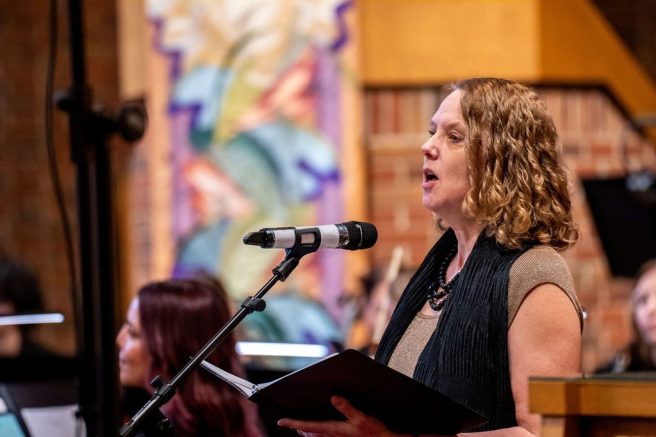
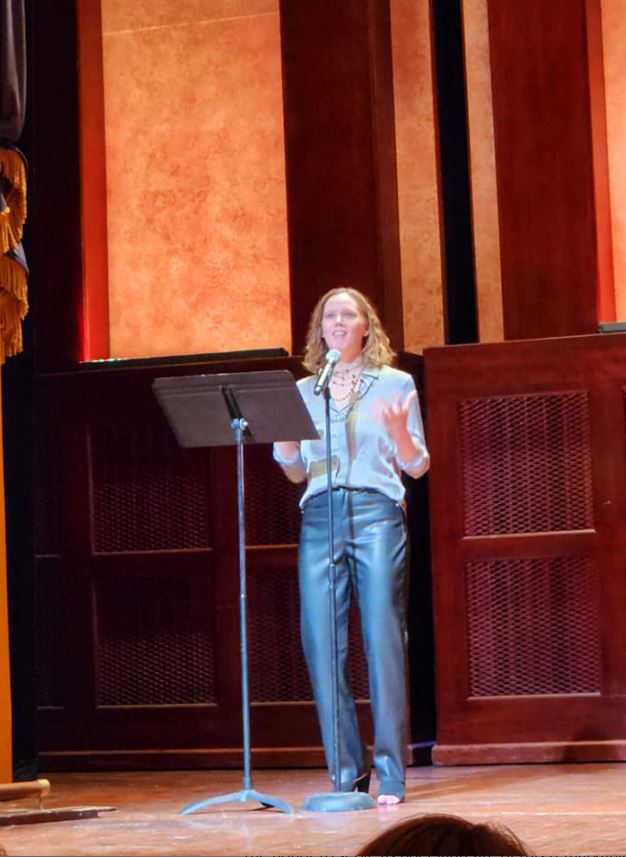
Reading my commissioned poem “Nightwalk” to open the 2025-26 season of the Worthington Chamber Orchestra

The theme of the season’s first concert, “Frontiers of Sound,” took a close look at America’s pioneering spirit and rich history. The program’s poetic and musical offerings reflected this theme in my commissioned poem, and in musical works honoring America’s spirit of innovation. I served as narrator on an orchestration of the Old Worthington Suite by the late Marshall Barnes, former professor of music theory and composition at the Ohio State University School of Music. Composed originally for narrator, flute, clarinet, and piano, and the orchestra, Barnes’ Old Worthington Suite glowed from within in Worthington composer Jacob Reed’s lush orchestration.

Also on the concert were Aaron Copland’s Billy the Kid, along with adventurous musical works by contemporary American composers Aaron Quinn and Jerod Impichchaachaaha’ Tate.
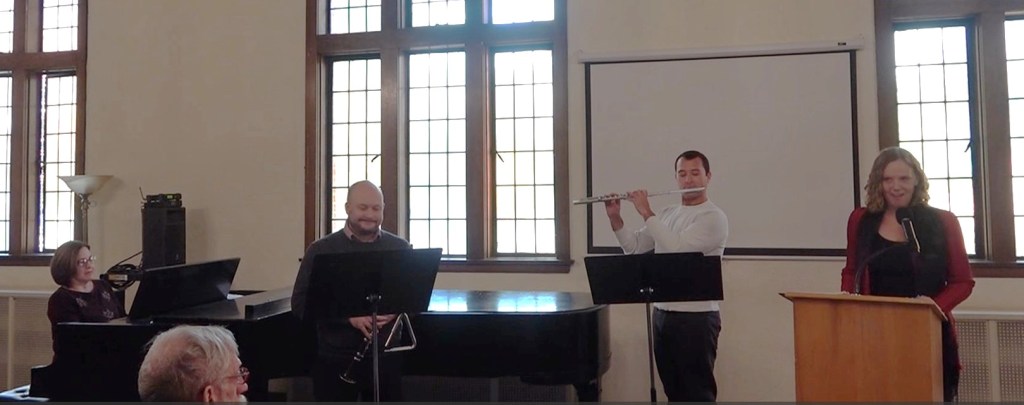
Narrating the original chamber ensemble version of Old Worthington Suite by Marshall Barnes, on the Worthington Chamber Orchestra’s “Frontiers of Sound: Community Connect” event

An accompanying event, Frontiers of Sound: Community Connect, brought the Worthington community together for a performance of the original chamber ensemble version of Barnes’ Old Worthington Suite, in which I performed as narrator. In my WOSU Classical 101 role, I also a panel discussion about historic Worthington’s past and present.

“Frontiers of Sound” marked the first concert of the orchestra’s season-long America250 celebration. The season’s concerts are united under the theme American Crossroads and explore in music the last 250 years of U.S. history and Worthington’s past, present and potential future.

Moderating a panel discussion on the Worthington Chamber Orchestra’s “Frontiers of Sound: Community Connect” event

Poetry Collection ‘a silence or two’ wins Merit Book Award

I am extremely honored and humbled that my most recent book, a silence or two (Red Moon Press), has received a 2025 Merit Book Award from the Haiku Society of America.

According to the Haiku Society of America, the HSA Merit Book Awards “recognize the best haiku and related books published in a given year in the English language.”

a silence or two is a deeply intimate poetic statement. It is raw, visceral. It deals with subject matter at once personal and universal—the body and it failings, trauma, death, loss, identity, and ultimately, the state of fractured wholeness so deep a part of our shared humanity in a broken world. This collection manifests in imagery and narratives that transcend the “objective realism” common to haiku to explore precarious terrain—namely the often unvoiced emotions hidden where flesh, soul, and spirit intersect in the depths of embodiment—for which expected languaging and usual modes of discourse are often insufficient.

Rattle poetry journal editor Tim Green and I discuss a silence or two extensively on Rattlecast.

It is significant that the emotional journey of this collection unfolds in haiku and short prose poems. Haiku tends to be viewed by poets and non-poets as a sort of toss-off genre unworthy of the kind of deep and rigorous study poets and literary scholars routinely devote to other genres. This common misconception and others, however, overlook centuries of profound and profoundly moving poetry in haiku’s original Japanese traditions and in the more recent though vibrant English-language tradition, to which the likes of Richard Wright, Sonia Sanchez, Jack Kerouac, Gary Snyder, and Jane Hirshfield have made significant contributions.

Common misconceptions about haiku also fail to consider that, like all other artistic genres and mediums, haiku invites exploration and the expansion of expressive possibilities. Indeed, haiku is a poetic vehicle uniquely and powerfully suited for conveying extraordinary ways of seeing the world and giving voice to the limitless depths of human emotion.

On every page of a silence or two, I broke the cardinal rules of English-language haiku and pushed other boundaries in ways that some would see as taboo. I am hugely gratified that HSA Merit Book Award competition judges Scott Mason and Patricia Machmiller saw the value of those risks for this book as a work of art and for the genre of haiku in English more broadly.

My deepest thanks and a deep bow to them. Deep thanks also to Jim Kacian and Red Moon Press for publishing this collection.

Poet Jennifer Hambrick Featured in Columbus Monthly Magazine

The “Creative Space” column in Columbus Monthly magazine, April 2025. Story by Peter Tonguette, photography by Tim Johnson. This photo by Jennifer Hambrick.

I’m honored to be featured in the “Creative Space” column of this month’s issue of Columbus Monthly magazine. I’m especially honored to be the featured artist during April—National Poetry Month.

Written by veteran arts writer Peter Tonguette, the “Creative Space” column highlights the unexpected spaces where selected Columbus artists find inspiration while creating new work. As Tonguette wrote, I found creative and gustatory nourishment to complete a poetry commission at The Whitney House restaurant, in Worthington.

In 2019, Columbus’ Sunday at Central concert series commissioned me to write a new series of poems for a multidisciplinary performance of The Four Seasons by Antonio Vivaldi, featuring music, spoken-word poetry, and live-mixed digital art projections. The four violin concertos in The Four Seasons had been published in the 18th century in an edition containing four sonnets, one devoted to each of the four seasons of the year.

The poems I drafted at The Whitney House update the sonnets published with the concertos, exploring the seasons of contemporary relationships in a blend of nature imagery—a nod to the original sonnets—and images drawn from present-day urban experience.

Every work of art is a mixture of countless silent and invisible ingredients—years of training, hours and hours of deep thought, the magic of inspiration. The place where the artwork was made, the environment that nurtured the artist’s ideas into new expressions, is almost never mentioned in an artwork’s creation story. But now it’s part of the story. Columbus Monthly’s “Creative Space” column is a testament to the creative vibrancy of Columbus, where art is nurtured where you’d least expect it.

If walls could speak.

Deep thanks to Peter Tonguette for featuring me and to photographer Tim Johnson for working his magic.

Featured Poetry Reading on Lit Youngstown Reading Series

Jennifer Hambrick reads on Lit Youngstown’s First Wednesday Readers Series, March 2025

It was an honor to give a featured poetry reading recently on Lit Youngstown’s First Wednesday Readers Series. My deep thanks to the wonderful Karen Schubert, Lit Youngstown founder and executive director, for inviting me to read.

Currently in its tenth year, Lit Youngstown enriches northeastern Ohio with a wide range of literary offerings, including readings, book discussions, writing workshops and camps, and a Fall Literary Festival encompassing writing in all genres. Each month Lit Youngstown’s First Wednesday Reader’s Series hosts readings by established writers in and beyond Ohio.

Learn more about Lit Youngstown on this episode of The Casey Malone Show, Youngstown’s arts and culture TV program, which filmed the segment during my reading on the series:

Poetry can happen anywhere – on the page, on the stage, in libraries, coffee shops, parks – even bowling alleys. Wherever there is a heart that bursts into poetry and ears and/or eyes to take it in, poetry has a home. And where there is poetry, there is the possibility to step out of our comfort zones, approach new ways to experience the world, and grow in empathy.

A Conversation with Rattle Poetry Journal Editor Tim Green on Rattlecast

I had the great honor and pleasure recently to join Tim Green, editor of Rattle poetry journal, as featured guest poet on his livestream, Rattlecast.

Tim and I had a really fun genre-bending conversation about poetry, music, and how music and my work as a classical musician, broadcaster, and cultural journalist informs my work as a poet – and vice versa. We also talked about how my work with music – and my mysterious poetry guardian angel – helped me become a poet in the first place. And I read from my most recent poetry collection, a silence or two.

Our conversation about words and music took place just before the publication of Rattle #85, which features a Tribute to Musicians, in which my poem “My Daddy Was an Appalachian Folksong” appears.

When I write poetry, I aim to make music with words. I spend a good deal of each day thinking and writing about music and considering how the sounds of words and the shapes of phrases and sentences can add up to vibrant writing that dances on the page and rattles in the mind’s ear.

The rhetoric of the physical body here is not strictly metaphorical. Poetry and music offer us powerfully embodied experiences as they work on and in us. We feel certain ways when we experience poems and music, and those feelings are emotional and physical.

I’ve always been fascinated by the sounds and feel of words, and also by how those sounds and feelings have come to mean what they mean. I was the kid who wondered, Gee, why do we call the sky “sky?” How did those particular letters and those particular sounds come to signify the great big blue expanse overhead? And how did “blue” come to signify the color of sky? Why not call it something else? And why call toes “toes?” Why call buttons “buttons?”

Of course, we can trace etymologies and find at least some of the ancestors of the words we speak and write today. But if I were to be teleported back in time and given the opportunity to meet the first person who ever spoke the proto-word that became “sky” or “toe” or “button,” I would ask him or her, What made you think to call this thing by these sounds?

Deep thanks to Tim Green for giving words space to dance and sing in the pages of Rattle, and for inviting me to share some of my words on Rattlecast.

Announcing the arrival of a silence or two

I am extremely excited to announce the publication of my most recent poetry collection, a silence or two, by Red Moon Press.

Hailed as “a stunning collection … destined to become a haiku classic,” a silence or two mines the territory of loss, healing, transformation, and joy in haiku and short prose poems that take the haiku form and narrativity between genres into new expressive ground.

Read advance praise for a silence or two from Cherie Hunter Day, Dr. Richard Gilbert, and Michelle Tennison and check out my other books on the Books page. You can also purchase copies from there (click on the book cover images) and through the Order page.

My deepest gratitude to Jim Kacian, founder and president of The Haiku Foundation and publisher at Red Moon Press, for guiding this collection into the world with such patience and care.

Inaugural Heliosparrow Frontier Awards Honor Cutting-Edge Poetry

Photo: via Wikimedia Commons Lisa Mastino, CC BY-SA 4.0

I’m humbled to have received four First Prize honors, three Honorable Mentions, and a Special Award for haiku recently in the inaugural Heliosparrow Haiku Frontier Awards.

All of the awarded poems and the judges’ fascinating and extremely rich commentary on them are published in Helioparrow Poetry Journal and in the flipbook at this link.

The awards were created by Dr. Richard Gilbert, professor emeritus of English, Kumamoto University, and one of the world’s leading theorists and critics of contemporary English-language haiku, “to present and praise leading-edge poems and poets illuminating inspiring directions in haiku poetics.”

All of the poems under consideration for the Frontier Awards were published in Heliosparrow Poetry Journal – the world’s leading publication of avant-garde English-language haiku and poems in related genres – which Gilbert founded and edits.

Gilbert, Heliosparrow co-editor Clayton Beach, and poet Michelle Tennison served as judges for the haiku, alterku (poems that expand the haiku form), sequence/collaborative poem, and short poem categories in the contest. I was also honored to judge the haibun category, and to join Gilbert, Beach, and Tennison in judging the alterku and sequence/collaborative poem categories, in which my own work was not in the running.

Far from traditional haiku rooted in the seasons of the non-human natural world, the poems recognized in the inaugural Heliosparrow Haiku Frontier Awards reinterpret the traditional haiku form through daring language, startling imagery, bold disposition on the page, and challenging subject matter and psychological nuance.

To read these poems is to look into the future of English-language haiku.

Poet Laureateship and Major Poetry Commission

Jennifer Hambrick performing as poet laureate of the 75th-anniversary season of the Chamber Music Columbus concert series, Southern Theatre, Columbus (photo by Antoine Clark)

The 2022-23 concert season recently came to a close and saw the culmination of a major poetry and music commissioning project in which I had the tremendous honor to be involved.

Jennifer Hambrick onstage in the Southern Theatre, Columbus, Nov. 2022 (photo by Antoine Clark)

Last season marked the 75th-anniversary season of the Chamber Music Columbus concert series, for I was honored to serve as poet laureate. The anniversary season unfolded in a year-long celebration involving the commissioning and public performances of seven new poems, the world premieres of more than a dozen commissioned musical works by internationally recognized composers, and seven concerts at Columbus’ historic Southern Theatre featuring some of the finest classical chamber music ensembles in the world.

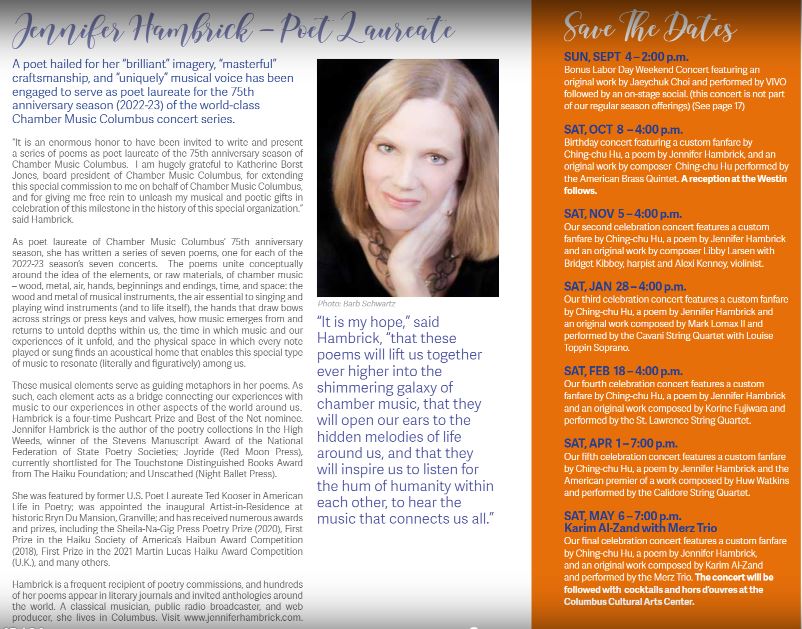
My involvement in the project came about in early 2021, when Katherine Borst Jones, president of the Chamber Music Columbus Board of Trustees and professor of flute at the Ohio State University, invited me to serve as poet laureate for Chamber Music Columbus’ 75th-anniversary season. The laureateship came with a commission to write an original poem for each of the seven concerts on the season and to perform a different one of my poems at the beginning of each concert.

Detail from the Southern Theatre, Columbus (photo by Jennifer Hambrick)

With this commission, Kathy gave me rein to let my imagination soar. As I wrote in my artist’s statement for the project, I crafted all seven of my commissioned poems conceptually around the idea of the elements, or raw materials, of chamber music – wood, metal, air, hands, beginnings and endings, time, and space. These musical elements serve as guiding metaphors in my poems, and each element acts as a bridge connecting our experiences with music to our experiences in other aspects of life and the world around us.

For three quarters of a century, Chamber Music Columbus has brought the finest chamber ensembles in the world to Columbus to perform. The roster of artists who have performed on this series through the decades reads like a Who’s Who of classical music.

Backstage at the Southern Theatre, before a concert of the Merz Trio, May 2023 (photo by Jennifer Hambrick)

The 75th-anniverary season continued that tradition with performances by some of the foremost classical music chamber ensembles on the international scene today – the American Brass Quintet, the duo of harpist Bridget Kibbey and violinist Alexi Kenney, the Callisto Quartet, the Cavani String Quartet and soprano Louise Toppin, the Calidore Quartet, the Merz Trio, and the musicians of the VIVO Music Festival.

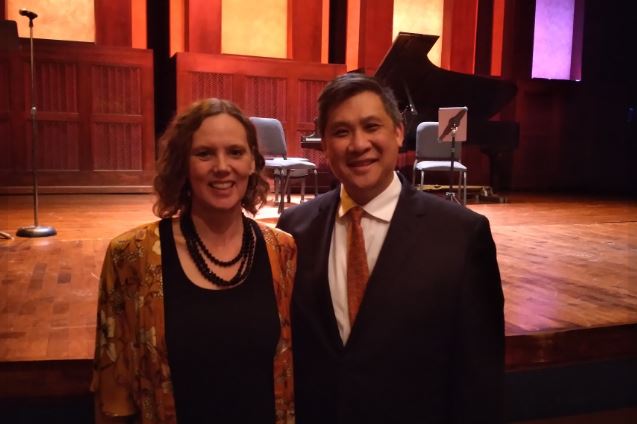
Jennifer Hambrick and composer Ching-chu Hu, May 2023, Southern Theatre, Columbus (photo by Juan Armando Rojas Joo)

These performers gave the world premieres of commissioned works by Libby Larsen, Huw Watkins, Karim Al-Zand, Mark Lomax, Korine Fujiwara, and Ching-Chu Hu.

My deep thanks to Kathy Jones and the Chamber Music Columbus Board of Trustees for extending me the honor to serve as poet laureate of this remarkable anniversary season, and congratulations on reaching this milestone.

Announcing the Arrival of Award-Winning Poetry Collection ‘In the High Weeds’

Jennifer Hambrick - In the High Weeds coverI’m delighted to announce the arrival of my most recent poetry collection, In the High Weeds, winner of the Stevens Manuscript Prize of the National Federation of State Poetry Societies.
Competition judge Jared Smith describes In the High Weeds as “an extraordinary journey from youth to maturity,” and writes, “The imagery is concise and brilliant, and the craftsmanship is masterful.”

Read Smith’s full commentary on In the High Weeds and purchase copies of the collection here

Copies of In the High Weeds are also available from the National Federation of State Poetry Societies, and through Amazon.

I am most humbled by the warm welcome Smith and others have extended to this collection, and most grateful to the National Federation of State Poetry Societies for supporting poets nationwide.

New Book ‘Fizzes’ With Offbeat Stories

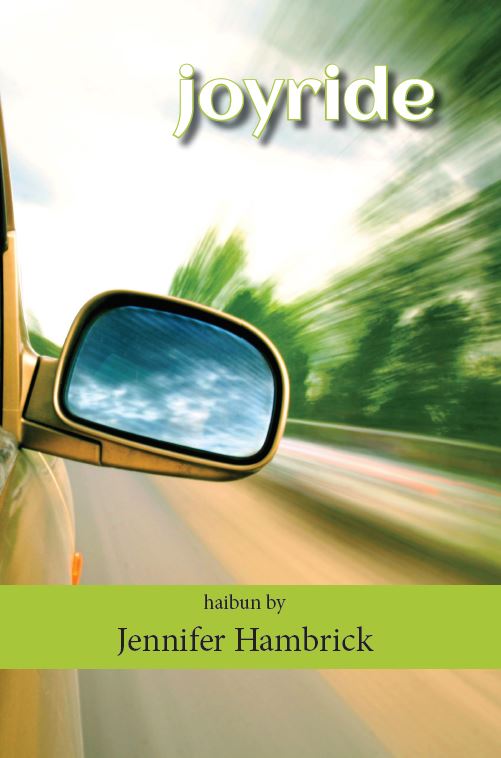
for-website-joyride-cover-3It’s been a rough year.  Couldn’t we all use a joyride?

I am delighted to announce the arrival of my most recent book, Joyride, from Red Moon Press.

Hailed as “a triumph” and “a beautifully written book, fizzing with marvelous imagery, energy, joie de vivre,” Joyride: A Haibun Road Trip is a lively mashup of flash fiction, memoir, free verse poetry, and haiku – an expansive take on the Japanese hybrid genre of haibun – that unfolds in offbeat episodes from the road of life.

You’ll meet a colorful cast of characters, and motoring through the collection are the automobiles – food trucks, used cars, moving vans, and others – that take us where we want to go and bring us home again. 

Read advance praise for Joyride and purchase your very own copy here.