The private self meets advancing age in two poems by dl mattila.
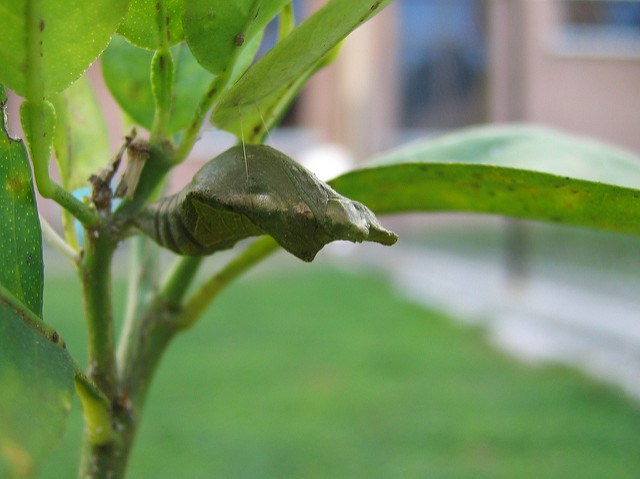
cocoon . . .
it’s what you don’t see
that defines me
In an age of endless social media confessions, it is important to remember that our selves were not meant to be always – or even ever – broadcast to the world. So often the cocoon is viewed only as a symbol of the butterfly that is to emerge from it. But there is essential beauty in what is inside the cocoon, not just in what is about to come out of it. It commands our respect. If only we’d stop tweeting and blogging long enough to notice.
***
advancing age
in my blind-spot
changing lanes
This sharp little poem leaves us on a cliff-hanger ending, even though Mother Nature has already spoiled the ending for us all. We don’t see age creeping up on ourselves until we try to shift our lives and run smack into it. But even though the younger driver may (really?) have the better reflexes, the older one has potentially more experience, more skill, and, as the character Evelyn Couch noted in the now classic film Fried Green Tomatoes, more insurance.
New Zealand poet Sandra Simpson packs the inner heat wave of menopause, the piquant flavor of a fourth marriage, and the beautiful death of big dreams into three lovely haiku.
heat wave –
holding the soft part of my wrist
under the tap
The term “heat wave” has a wonderful double resonance as the natural phenomenon of a period of scorching outdoor temperatures and as a metaphor for the hot flashes that often come with the equally natural process of menopause. Either way, one can imagine seeking relief from the external or internal heat by holding the sensitive flesh of the underside of the wrist beneath a trickle of cool water, a common remedy for the discomfort of hot flashes.
***
the water jug
stuffed with mint & lemon –
her fourth husband
Far richer than the purity of the first marriage, the water jug in the first line, which I read as representing the fourth marriage, is packed with stuff – natural, earthy, fragrant, and tasty stuff, but stuff nonetheless. The stuff of a life full of experience – the astringency of previous marital loss, the minty coolness of taking it all in stride. Far from plain old spring water, the water in the jug is infused with the perfume of many lifetimes.
***
blossom wind –
too late now to be
who I wanted to be
The moment when you realize you’ll never play professional baseball. Or become a great chef. Or become a parent. This wistful poem represents that moment as the part of the self that dreams our dreams – which is to say, the deepest part of the self – dying, drifting away like flower petals on a spring breeze. And that breeze – that “blossom wind” – is historically especially good at blowing women in every direction – into and out of marriages, from location to location as trailing spouses, into motherhood, out of careers. At the same time, this poem also transforms that deep and dreamy part of each of us into something it never dared to imagine it could become: the simple, perfect petal of a flower.
Sandra Simpson co-organised the 2012 Haiku Festival Aotearoa (New Zealand) and in 2018 is co-editing the Fourth NZ Haiku Anthology. Sandra is the founding editor of the online Haiku NewZ (2004), has been secretary of the Katikati Haiku Pathway Committee since 2006, and South Pacific editor for the annual Red Moon anthology since 2012. She has won several awards for her haiku and judged international competitions. Sandra published a collection of her haiku, breath, in 2012 and from the same year has had her own haiku blog, also called breath. She grows orchids as a hobby.
A disenvoiced woman screams on the inside, and a widow explores new-found freedom in two lovely haiku by U.S. poet Claire Vogel Camargo.
the silence
of her acquiescence
a scream
Whatever the subject of the poem is acquiescing to, with whatever wrong or misdeed she is rendered voiceless, a scream resounds inside her. You will likely not hear it – not yet, anyway – but it is there. It is the scream that says this is horribly wrong, you don’t deserve this, no one deserves this, this must stop. “This” could be any number of things – rape, abuse, harassment, discrimination, mansplaining, a good old-fashioned scolding by a male co-worker or spouse. The list goes on. And because personal safety and livelihood may well be at stake, “the silence / of her acquiescence” often goes on, too, despite all the screaming inside.
***
just widowed
all she accomplishes
without him
It’s not necessarily the case that he was a demanding husband. He might have been wonderful and supportive, as many husbands are. But before his death, she shared her space, her time, her life with him. She made his interests hers. She flexed with his schedule. Like Golde in Fiddler on the Roof, she may have washed his clothes, cooked his meals, cleaned his house. It was her house, too, of course. But still. Now, after his death, she is her own woman and, seemingly, well at ease.
Claire Vogel Camargo, author of IRIS OPENING, an ekphrastic collection, wrote her first haiku in 2010, which won 1st place. Her poems appear in journals and anthologies – including Cattails, Hedgerow, Lifting the Sky: Southwestern Haiku & Haiga, Presence, and World Haiku Review. Her 1st place haiku (My Haiku Pond Academy 2017) was the prompt for Carpe Diem Troiku Kukai “in the herb garden” January 2018. She holds degrees in nursing (BSN, MSN) and belongs to the Austin Poetry Society board, British Haiku Society, and Haiku Society of America. She lives with her husband and Great Dane in Texas.
British poet Martha Magenta gives voice to the reprehensibility of sexual harassment, the after-effects of a mastectomy, and fleeting fertility in three beautiful haiku.
the depth
of pollution
#metoo
What prompts one to think it acceptable to make implicit or explicit sexual demands of someone else? The impulse may or may not be akin to the one that prompts the polluting of a beautiful landscape with an empty potato chip bag, but the results are similar: both victims are left to drown in the filthy residue left behind by those who violate them.
***
last rose of summer –
the loneliness
of a single breast
In the normal course of things, we shed cells throughout our entire lives, such that every several years we effectively have entirely new bodies. So why should it surprise us when a part of our bodies must be removed all at once? It surprises us, of course, because we are gifted with the propensity to envision only our springtime and summers, not our autumns and (heaven forbid) our winters. A lone breast shares this lovely haiku with a late-blooming rose, offering the gentlest possible reminder both of our mortality and of its place, and its special kind of beauty, in the natural order.
***
falling sakura . . .
her yearning
to conceive
What image better conveys the yearning for new life than the sakura – the cherry blossom – that timeless Japanese symbol of the fragility of life? In this poem, the biological clock measures time in cherry petals let loose from the tree, even as the poem’s subject likely marks time in monthly cycles, in squares on the calendar, and in temperature readings. This, too, is life.
Martha Magenta lives in Bristol, England, UK. Her haiku, haibun, senryu, and tanka have appeared in a number of journals, magazines, and anthologies. She was awarded Honourable Mentions for her haiku in The Fifth Annual Peggy Willis Lyles Haiku Awards, 2017, and the 71st Basho Memorial English Haiku Contest, 2017, and for her tanka in UHTS “Fleeting Words” Tanka Contest 2017. She is listed on The European Top 100 haiku authors, 2017.
A kept woman and a white wedding dress find their way into two insightful haiku by Lee Nash.
sugar daddy
the acrid sting
of his tobacco
The kept woman. Wouldn’t it be nice, the idea goes, if a man could provide a woman everything she needs, or – better yet – could spoil her outright, just like her father did when she was a little girl, only with bigger, blingier, costlier gifts? Of course, whatever sum the sugar daddy spends, the woman’s emotional price – her sense of her own inner strength and resourcefulness, her self-respect – is far costlier. The “acrid sting” lands in her soul, while material stuff builds up around her like prison walls.
***
white wedding dress
the intensity
of a sugar rose
Are many weddings these days, euphemistically speaking, white? Sure, the bride’s dress may gleam like the cliffs of Albion, but does the dress still convey virginity, as it did in past eras? One can still “read” a white wedding dress that way, though I suspect most would also consider doing so to be old-fashioned and, frankly, none of their business. Yet, the white dress persists as a bride’s default wedding attire, maybe because of or despite the symbol it once clearly was, or maybe – dare I say it? – just for show. So now compare, as Nash does in her poem, the white wedding dress with not a real rose, but a sickly sweet one made of sugar. And it’s only fair to ask: Which article of the groom’s attire still, even if only in the margins, satisfies social expectations of his sexual status at the altar?
Lee Nash lives in France and works as an editor and proofreader. Her poems have appeared in print and online journals, including Acorn, Ambit, Angle, Magma, Mezzo Cammin, Orbis, Poetry Salzburg Review, Sentinel Literary Quarterly, The Heron’s Nest, and The Lake. Her first poetry chapbook, Ash Keys, is available from Flutter Press. You can find a selection of Lee’s poems on her website: leenashpoetry.com.
Launching the 2018 International Women’s Haiku Festival are two gorgeous haiku by Canadian poet Debbie Strange.
Taken together, these two poems convey volumes about women’s experience. In “sisterless . . .” the special relationship that only sisters can share is viewed from the vantage point of its utter lack, and illustrated with the heartrending image of a star falling into permanent darkness in a lake.
“African violets” is a compassionate take on the parts of our lives that we may prefer to leave in the relative safety and comfort of the vagueness of the past. Likening the “fuzzy details” of the past to bold and beautiful (and, yes, fuzzy) African violets acknowledges that even the shadows of one’s past are still, in their own unique ways, beautiful and brilliant.
sisterless . . .
another star falls
into the lake
***
African violets
the fuzzy details
of my past
Debbie Strange (Canada) is an internationally published short form poet, haiga artist and photographer whose creative passions bring her closer to the world and to herself. She is the author of Warp and Weft: Tanka Threads (Keibooks 2015) and the haiku chapbook A Year Unfolding (Folded Word 2017). You are invited to visit her publication archiveat http://debbiemstrange.blogspot.ca/.
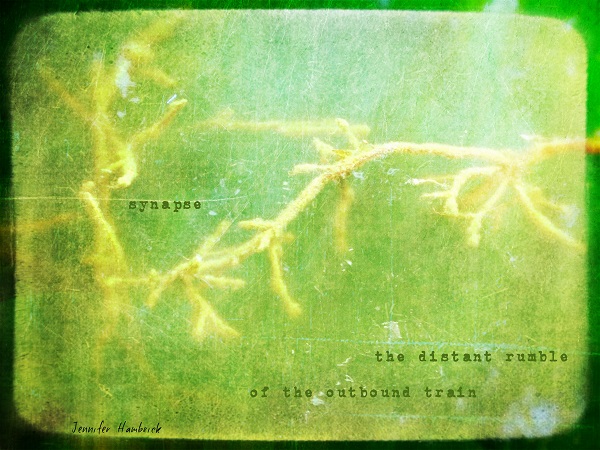
Anyone who creates on a regular basis knows that the process that leads to a creation is almost always as original as the creation itself. In the case of my haiga “synapse,” published recently in the beautiful online journal DailyHaiga,I thought a before-and-after might be of interest.
It was actually the edited version of the photograph in “synapse” that inspired the haiku that now accompanies it. The edited image is above; here is the unedited photograph:
In the unedited, photo it’s a bit more clear that the light yellow network of fibrous tentacles is actually a meandering aquatic plant floating in water – in this case, a pond – just beneath the surface.
In editing the photo, I wanted to bring out the contrast between the yellow plant and the greenish hue of the water. So I moved briskly to the electric end of the color spectrum and also applied some other filters to add a retro urban feel.
I sat quietly for a while looking at the edited photo and exploring my inner landscape in relation to it, asking myself how the colors made me feel, what, in the abstract, that yellow thing kind of looked like, and so on.
Then I listened to my intuition, which told me that the yellow tentacles looked like either a subway map or a medical image of a nerve cell ganglion – no, they looked like both at once!
The two contrasting interpretations of the photo’s subject practically handed me the two components of the haiku on a platter: “synapse,” as in a nerve cell synapse, and “the distant rumble / of the outbound train,” referring to the subway map interpretation of the yellow vine.
My deep thanks to DailyHaiga editor Linda Pilarski for again publishing my work.
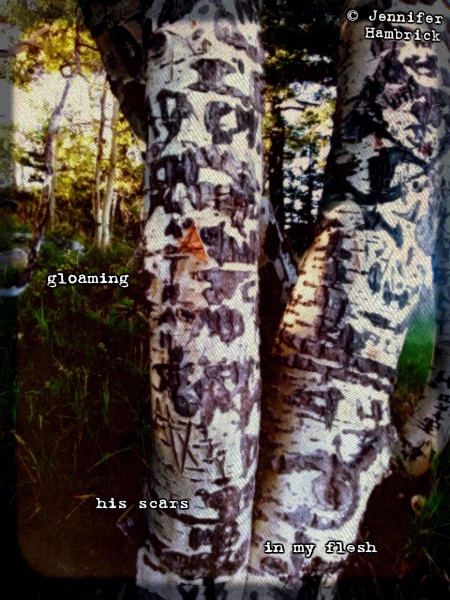
I have never carved my initials into a tree. Here’s why: Imagine what it would feel like if someone were to gouge some random etching into your flesh with a sharp – or worse, a strong but more or less blunt-edged – instrument.
Every word I’ve heard has left its mark on me on a cellular level. Such is the nature of who we are as human beings interconnected in a web of emotions. More to the point, the scars of those I love, and of those I once loved, are still with me and may always be.
I am most grateful to contest judge Kuniharu Shimizu for selecting my work for this honor.
I was delighted to have another haiga published recently in the journal DailyHaiga.
Pictured in this haiga is a detail of the bottom of a water chain surrounded by pebbles, a wooden border and fronds of a plant. I took the photo during summer in the Japanese Garden at the phenomenal Schnormeier Gardens in Gambier, Ohio.
The tranquil elegance of this distinctly Japanese scene gave rise to thoughts of a lazy summer day and to the haiku that I included with the image.
And even though summer’s over and we’re deep into a glorious autumn, we can take that summer feeling – warm, lazy days when everything seems to move at a slow trickle – wherever we go.
I am extremely grateful to DailyHaiga editor Linda Pilarski for again publishing my work in this major haiga journal.
I shot the photographs in all of these haiga in June 2017 at the stunning Schnor-meier Gardens, in Gambier, Ohio, then used various digital photo editing techniques to add borders and other effects.
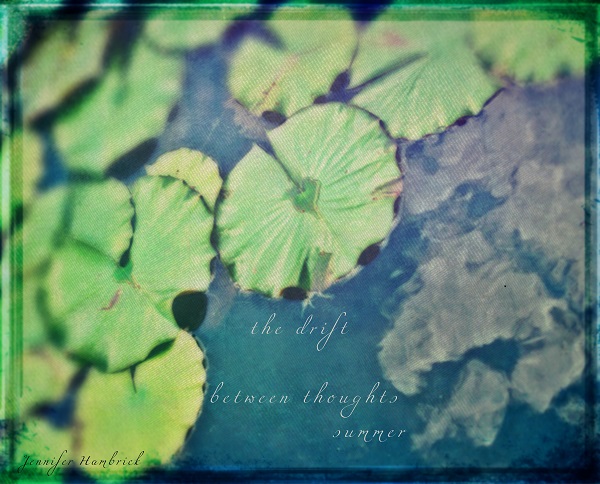
In “the drift,” shown at the top of this post, and in “the cool slide,” each of the visual images in its edited form inspired the haiku that accompanies it.
In “the drift,” water becomes one with the sky reflected in it. together, they take on the role of a fluid, boundless medium through which thoughts can flow as freely as a summer breeze.
The photo in “the drift” is of one of the garden’s amazingly beautiful lily ponds, which were coming into full bloom during my visit. I decided on the particular combination of editing filters because of the effect they created on the clouds, which swirl in that lazy summer afternoon kind of way.
In “the cool slide,” water becomes the pathway for a kind of experience with dementia that differs from the horrifying response this traumatic condition usually evokes. The eye slides from a rocky shore into gentle sky-blue water, metaphorically away from the harsh ugliness of the world and into peaceful depths. Maybe there can be spiritual benefits to forgetting.
The image in “the cool slide” is of the edge of one of the lakes in the Schnormeier Gardens’ Serenity Garden, which also features trickling streams, two waterfalls, a young forest of more than 200 rare conifers, and a Japanese garden house.
In “spring tide,” the rough edges of the piece of sea glass became the idea that guided me to create a poem about the wabi-sabi kind of beauty in one’s own rough edges, and the special compassion of the people who choose to accept them and, indeed, even see beauty in them.
Many sincere thanks to Haiga Online editor Linda Papanicolaou for selecting my work for this special “Borrowed Water” issue.







 jenniferhambrick.com