Poem Wins Sakura Award in 2017 Vancouver Cherry Blossom Festival International Haiku Invitational

Cherry Blossoms - Susanne Nilsson
Photo: Susanne Nilsson (Creative Commons/Flickr)

I was surprised and delighted to learn from a fellow haikuist that one of my poems recently received a Sakura Award in the 2017 Vancouver Cherry Blossom Festival International Haiku Invitational.

My haiku was one of 15 by U.S. authors recognized with Sakura Awards in this year’s competition. In addition, a single poem was named Top Winner in the U.S. category, and another 25 U.S. poems were given Honourable Mentions.

Of the 41 U.S. poems granted awards, fully six – close to 15 percent – are by poets living and working in my home state of Ohio.

The theme of this year’s Vancouver Cherry Blossom Festival Haiku Invitational was “freedom.” My poem speaks to the world of possibilities that await people of all ages and from all corners of the globe who seek to build their lives in freedom and peace:

an old man
learns two new words
cherry blossom

My heartfelt congratulations to the winning poets in all divisions of this year’s competition, and my sincere gratitude to the competition judges, Angelee Deodhar, Billie Wilson, and DeVar Dahl.

“Stiletto heel” Haiku Published in The Mainichi (The Daily News – Japan)

The Mainichi imageWhat a pleasant surprise!

I  just discovered quite at random that one of my haiku was published recently in the major Japanese newspaper The Mainichi (The Daily News).

Here is my poem:

Hambrick stiletto heel haiku The Mainichi 18 April 2017

My thanks to editor Isamu Hashimoto for selecting my work. I am greatly honored.


International Women’s Haiku Festival: Poems by Michelle Schaefer

why is the sky blue?

Photo: Optick/Creative Commons/Flickr

Michelle Schaefer writes of lace and sea glass in today’s feature of the International Women’s Haiku Festival.

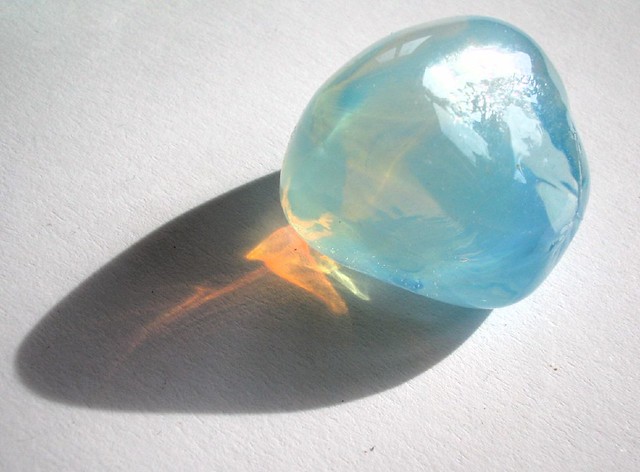
sea glass
I find myself
piece by piece

With its sharp edges worn smooth by the tumult of the ocean, “sea glass” is a beautiful metaphor for what, ideally, happens to us over the course of our lives.  The self-possessed older woman who embodies that special kind of ease in her own skin didn’t necessarily get there easily or overnight.  She likely had to comb a lot of beaches and pick up loads of flotsam and jetsam before finding the lovely sea-gems that sit well in her soul.  Schaefer’s poem gives us a road map – let the ocean of life smooth out our rough edges – and reveals the wabi-sabi kind of beauty of the works-in-progress that we are.

***

the edge of lace
no
still means no

The classic decoration for women’s undergarments, lace is a vivid signifier of feminine sexual intimacy.  Intriguingly, “the edge of lace” is serrated like a knife blade and, in Schaefer’s poem, suggests a protective boundary or even a weapon against sexual violence.  The lace metaphor here is an extraordinary symbol of a woman’s right to autonomy and a reminder of boundaries that are not to be transgressed.

Michelle Schaefer is a poet-in-progress.  She has spent many years learning and writing the art form of haiku.  She has been published in various haiku journals and anthologies.  Her poetry can be found in Acorn, Frogpond, Modern Haiku, Mariposa and Heron’s Nest.  She is also featured in NY Seitkatsu’s online publication as a regular semifinalist in the Ito En Haiku Grand Prix.  She has recently won Frogpond‘s Museum of Haiku Literature Award in its most recent volume.  She hopes that poetry touches people in extraordinary ways.  She lives in Bothell, WA with her husband.

International Women’s Haiku Festival: Poems by Stella Pierides

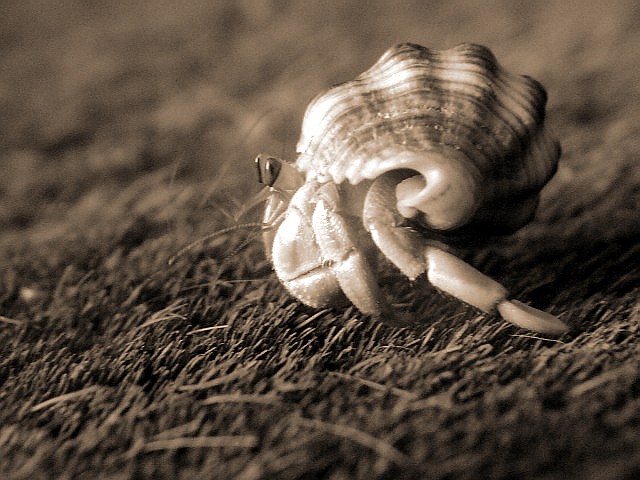
land hermit crab

Photo: Vanessa Pike-Russell/Creative Commons/Flickr

Laughing babies meet hermit crabs in two haiku by Stella Pierides in today’s feature of the International Women’s Haiku Festival.

juggling
a pen and a feeding spoon –
the baby’s laughter

This senryu captures a moment of the happy chaos babies bring with them everywhere.  The baby is probably laughing because he or she feels secure and happy in the presence of a familiar care taker.  But what about this whimsical possibility: The baby laughs along with us at the humorous image of the parent “juggling” pen and feeding spoon?  In any event, this laughing baby, like all laughing babies, gets the last laugh – from us.

***

hermit crab –
while ironing she dreams
of other lives

Confined to its shell, the hermit crab rarely, if ever, leaves its home.  What if the woman in this haiku could leave her shell and leave behind her domestic chores?  Would the “other lives” of which she dreams live up to her fantasies and justify sacrificing the security of her status quo?  Maybe what the woman really wishes for is simply to know she has the freedom to choose a different path and define herself anew.

Stella Pierides was born in Athens, Greece and now divides her time between Neusäss, Germany, and London, England.  She is the author of Of This World (Red Moon Press, 2017); In the Garden of Absence (Fruit Dove Press, 2012), for which she received a Haiku Society of America Merit Book Award; and Feeding the Doves (Fruit Dove Press, 2013), among others.  Stella serves on The Haiku Foundation board of directors and project manages the Per Diem: Daily Haiku feature for the Foundation. She enjoys reading, gardening, film, music, food, and working long hours.

Find more information about the International Women’s Haiku Festival and submit your work at this link.

International Women’s Haiku Festival: Poems by Shloka Shankar

HPIM0944a

Photo: Michael Koolman/Creative Commons/Flickr

Shloka Shankar writes of goddesses and Rorschach tests in today’s feature of the International Women’s Haiku Festival.

omniscient narrator the goddess in me awakes

The poetic speaker’s mind generates a metanarrative of the population of her inner landscape.  At once, she is narrator and goddess and all of those other characters who live in her soul.

***

Rorschach test
the side you choose
to ignore

This poem lays bare the reality of our human hypocrisy.  We believe what we want to believe.  Especially about ourselves.

Shloka Shankar is a freelance writer from Bangalore, India.  She has happily found her niche in found poetry and Japanese short-forms alike.  Her work has appeared in close to 200 print and online venues of repute.  She co-edited naad anunaad: an anthology of contemporary world haiku (Vishwakarma Publications, 2016) and is a Best of the Net nominee.  Shloka is the founding editor of the literary & arts journal Sonic Boom.

Find more information about the International Women’s Haiku Festival and submit your work at this link.