International Women’s Haiku Festival: Poems by Stella Pierides

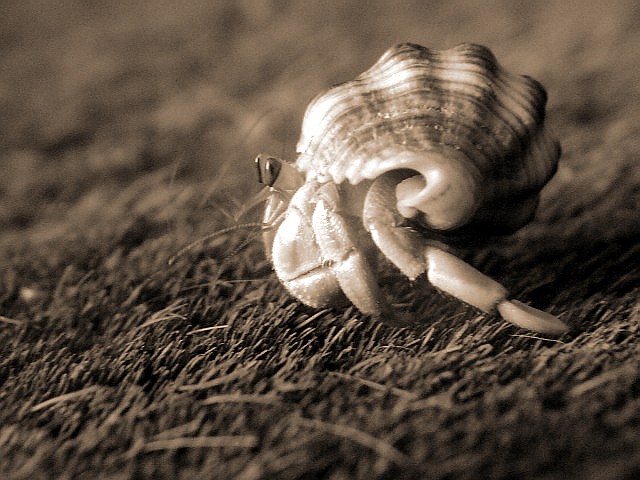
land hermit crab

Photo: Vanessa Pike-Russell/Creative Commons/Flickr

Laughing babies meet hermit crabs in two haiku by Stella Pierides in today’s feature of the International Women’s Haiku Festival.

juggling
a pen and a feeding spoon –
the baby’s laughter

This senryu captures a moment of the happy chaos babies bring with them everywhere.  The baby is probably laughing because he or she feels secure and happy in the presence of a familiar care taker.  But what about this whimsical possibility: The baby laughs along with us at the humorous image of the parent “juggling” pen and feeding spoon?  In any event, this laughing baby, like all laughing babies, gets the last laugh – from us.

***

hermit crab –
while ironing she dreams
of other lives

Confined to its shell, the hermit crab rarely, if ever, leaves its home.  What if the woman in this haiku could leave her shell and leave behind her domestic chores?  Would the “other lives” of which she dreams live up to her fantasies and justify sacrificing the security of her status quo?  Maybe what the woman really wishes for is simply to know she has the freedom to choose a different path and define herself anew.

Stella Pierides was born in Athens, Greece and now divides her time between Neusäss, Germany, and London, England.  She is the author of Of This World (Red Moon Press, 2017); In the Garden of Absence (Fruit Dove Press, 2012), for which she received a Haiku Society of America Merit Book Award; and Feeding the Doves (Fruit Dove Press, 2013), among others.  Stella serves on The Haiku Foundation board of directors and project manages the Per Diem: Daily Haiku feature for the Foundation. She enjoys reading, gardening, film, music, food, and working long hours.

Find more information about the International Women’s Haiku Festival and submit your work at this link.


International Women’s Haiku Festival: Poems by Martha Magenta

20150205_163920.jpg

Photo: Mo Barger/Creative Commons/Flickr

Martha Magenta turns mammogram shadows upside down and sees dignity in dementia in today’s feature of the International Women’s Haiku Festival.

mammogram
my shadow
leads the way

Shadows usually follow us, not lead us.  Magenta’s turning that truth on its head is wonderfully playful – or would be, if the shadow in question weren’t the shadow on the mammogram image that every woman dreads.

***

knitting a shawl
grandmother folds
into the fog

This poem is a rich and dignified picture of generational role reversal.  The verb “folds” so gently unites the knitting work-in-progress with the grandmother who is fading into the fog of sleepiness or dementia – or both.  Was it perhaps the grandmother who taught the poetic speaker to knit?  If so, then those stitches weave the speaker and the grandmother together through the DNA of a beautiful handicraft passed down through generations.

Martha Magenta lives in England, UK. Her poetry has appeared in The Reverie Journal, Cafe Aphra, and Beaux Cooper; her haiku and senryu have been published in Modern Haiku, Presence, and Chrysanthemum, among others; her tanka in The Bamboo Hut, and Ribbons. She is owner of POETS community on G+. She collects her published work on a blog: https://marthamagenta.com/.

Find more information about the International Women’s Haiku Festival and submit your work at this link.
International Women’s Haiku Festival: Poems by Michael Dylan Welch

Cedar Forest

Photo: Jerry Meaden/Creative Commons/Flickr

Michael Dylan Welch writes of cedars and doilies in today’s feature in the International Women’s Haiku Festival.

rust in the cedars –
we gather again
at her favourite spot

Whose favorite spot?  A grandmother’s?  A sister’s?  A friend’s?  We don’t know, but the “rust in the cedars” and the ritual (“again”) gathering suggest the remembrance of someone now gone.  This poem rings with music: The musical sibilants in the first line – “rust in the cedars” – open the poem with a reverential whispering.  The assonance of the hard G’s on both accented syllables in the second line – “we gather again” – is a gently percussive counterbalance to the hushed first line.  There seems to be a stillness at this gathering, a moment in which to contemplate the imponderable realities of interconnection and the cycle of life.

***

lazy day at granny’s –
the doily imprint
on my daughter’s cheek

There’s an entire world in the 11 words of this senryu.  This granny with her doilies – you can see her furniture, you can hear the creak of her floors.  And the filigreed imprint of the doily on the girl’s cheek connects the girl with that family home, a sanctuary of complete and total safety.  The assonance and swung rhythm of “lazy day” intertwines seamlessly with the alliteration of “day,” “doily,” and “daughter,” uniting musically the people, time, place, and mood of a moment of simple yet profound family joy.

Michael Dylan Welch recently served two terms as poet laureate for Redmond, Washington, where he also curates two poetry reading series and directs the annual Poets in the Park festival. He runs National Haiku Writing Month (www.nahaiwrimo.com), and is a director of the biennial Haiku North America conference. Michael’s haiku, tanka, longer poems, essays, and reviews have appeared in hundreds of journals and anthologies, and one of his translations appeared on the back of 150,000,000 U.S. postage stamps. His personal website is graceguts.com. Michael lives with his wife and two children in Sammamish, Washington.

Find more information about the International Women’s Haiku Festival and submit your work at this link.

International Women’s Haiku Festival: Haiku by Willie R. Bongcaron

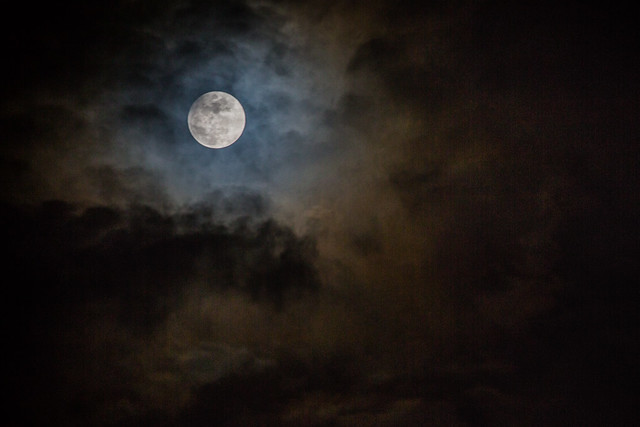
The moon

Photo: Laurie Shaull/Creative Commons/Flickr

The International Women’s Haiku Festival continues with a lovely haiku about solitude by Willie R. Bongcaron.

full moon
she stands alone
not so lonely

This poem gives graceful voice to a vexing issue.  Traditionally, women have been defined – and often still are defined – by their relationships with the men in their lives.  In the West, at least, daughters take their father’s last names, and traditionally, women take their husband’s last names.  When a woman is unattached, and in particular, not married to a man, does the world accept her as the complete human being she is, or does she tend to be viewed simply as someone who lacks a spouse?

In Bongcaron’s poem, the moon reflects the radiance of a woman comfortable in her solitude, a woman who stands on her own two feet, well at ease.

Willie Ropelos Bongcaron is a haijin by choice.  He has adopted a pen named AoSuzume, or the blue sparrow, with the help of Ms. Gabi Greve.  He is an adherent of short poetry forms like haiku, senryu, tanka, haiga, free verse, etc, but has been particularly addicted to haiku and senryu for 5 or more years now.  He resides in Sampaloc, Manila, the Philippines with his family; and is a government employee, having worked with the light rail transit system (LRTA) since 1985.

Find more information about the International Women’s Haiku Festival and submit your work at this link.
International Women’s Haiku Festival: Terri L. French

dark alley

Photo: Renee McGurk/Creative Commons/Flickr

Terri L. French talks homelessness, lip service, and tampons in today’s feature in the International Women’s Haiku Festival.

curses–
a homeless teen
stealing tampons

The Curse, that monthly guest, joins up with the dreaded curse of homelessness and all the woes that fly out from its Pandora’s box.  French captures the desperation of the impoverished young woman with a boldness and directness that hits you in the gut and makes you weep for the world.

***

lip service
her voice falling
on deaf ears

The phenomenon of what I call disenvoicement – the unjust silencing of an individual on real or perceived threat of devastating consequences for speaking out – is a sinister reality in the lives of women.  In so many ways a woman’s voice falls on “deaf ears” – the physically or emotionally abused woman or girl is afraid to speak out against her abuser, the professional woman is afraid to speak from her unique perspective in a meeting full of male colleagues, the silenced woman who, in some cultures, is viewed as a being without basic human dignity simply by virtue of her sex – the list goes on.  This tragedy plays out on the social and individual levels; how much worse off the world is when deprived of these voices!  French’s poem aptly gives voice to a grave wrong in women’s experience that has gone on far too long.

Terri L. French is a writer/editor and award winning haiku poet living in Huntsville, Alabama. She is past Southeast Coordinator of the Haiku Society of America, former editor of the senryu and kyoka journal Prune Juice, and current secretary for The Haiku Foundation.

Find more information about the International Women’s Haiku Festival and submit your work at this link.
International Women’s Haiku Festival: Haiku by John Hawkhead

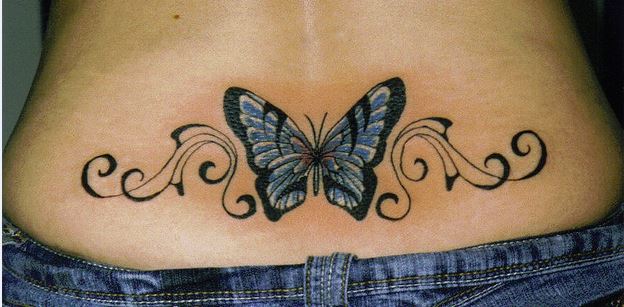
butterfly-tattoo-10-by-ilfrita-ilfi-creative-commons-flickr

Photo: Ilfrita Ilfi/Creative Commons/Flickr

British poet John Hawkhead talks tattoos and butterflies in today’s feature of the International Women’s Haiku Festival.

tattoo butterfly
fading into her wrinkles
wind through Autumn leaves

This poem tells so many life stories in just seventeen syllables.  But even juicier than the details Hawkhead gives us – the older woman, her butterfly tattoo – are the ones he leaves out: Where is that tattoo, and how large is it?  And that wind stirring the Autumn leaves – is it the tail wind in the wake of her hog?  Her significant other’s hog?  Her red Mustang?  Her self-assured gait?  Her wheelchair?  Her freedom is as enviable as it is colorful.  I want to meet this woman.  Some days, I even want to be her.

John Hawkhead is a writer an illustrator from the South West of the UK who is widely published in haiku and poetry magazines around the world. His book of haiku is available from http://www.albapublishing.com/. His Twitter account is at: https://twitter.com/HawkheadJohn.

Find more information about the International Women’s Haiku Festival and submit your work at this link.

International Women’s Haiku Festival: Poems by Anna Cates

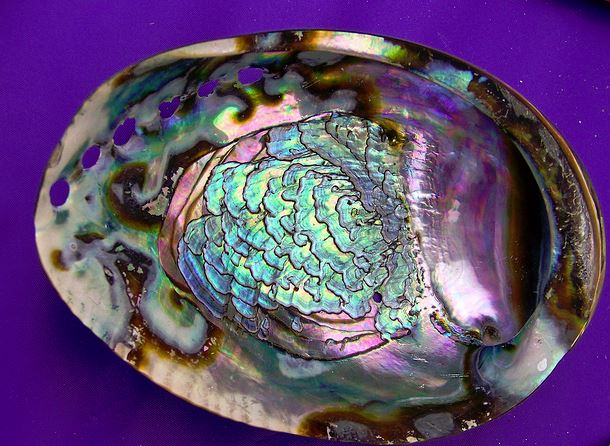
mother-of-pearl-photo-from-creativie-commons-flickr

Photo: Rojer/Creative Commons/Flickr

Today the International Women’s Haiku Festival features poet Anna Cates. Two of her haiku are alive with flowers and sunlight, smooth pastels and mother of pearl.

lady’s mantle
the sunlight
on my shoulders

This poem renders a haiku moment in the most gracious and vivid terms.  You can almost see an impressionist painting: A woman sits next to a window or en plein air, summer sun warming her shoulders as he admires clusters of dainty lady’s mantle.  The woman enjoys sitting in the sun, while the lady’s mantle is content to wear its golden glow in the shade.  The woman and the flowers are twin sisters.

***

mother of pearl
still inside her shell
smooth pastels

How does the mollusk do it, create that iridescent, otherworldly mother of pearl?  All of that is going on inside the shell’s hard, creviced exterior.  It’s as though the sea creature, wary of leaving its shell and rendering itself unprotected, makes its own comfortable satin sheets.  This poem acknowledges the vulnerability that haunts every girl or woman who, at whatever stage of life, longs to leave her shell and put her mark on a man’s world.  But it also slyly suggests that maybe staying in the shell that she has, by her own talents, made so exquisite is okay, too.  The choice is hers.

Anna Cates lives in Ohio (USA) with her two cats and teaches English and education online. One hundred of her short form poems appear in the Living Haiku Anthology.

Find more information about the International Women’s Haiku Festival and submit your work at this link.

International Women’s Haiku Festival: Poems by Agnes Eva Savich

Summer Fades Away [244/366]

Photo: Tim Sackton/Creative Commons/Flickr

This month, in celebration of National Women’s History Month, Inner Voices is hosting the International Women’s Haiku Festival. Throughout the month of March, you will find here haiku about women, women’s experience, and women’s unique contributions, written by poets from around the world.

Launching the festival today are two haiku by Agnes Eva Savich.

rosy cheeks
she picks a fistful
of cherry tomatoes

This poem captures a double moment of joy: that of harvesting the juicy treasures of the vine, and that which the poetic speaker – perhaps in the role of mother or grandmother – experiences in watching the rosy-cheeked girl’s moment of discovery.  The mirror imagery of the rosy cheeks and the rosy roundness of the cherry tomatoes in the girl’s fist is delightful.

***

breast cancer
sprinklers on full blast
across a church lawn

Here, the “sprinklers on full blast” are a darkly clever amplification of a chemo drip.  That those sprinklers are flooding the lawn of a church emphasizes the depths of the fear that extends from the devastating diagnosis to the possibility that, in times of human desperation, even divine power has its limits.

Agnes Eva Savich lives near Austin, TX with her husband, two kids, and four cats. She has been writing poetry since she was 12. Her haiku are published in many modern haiku journals and have been translated into five languages. She has an early collection of poetry, The Watcher: Poems (Cedar Leaf Press, 2009) and is working on her first haiku collection.

Find more information about the International Women’s Haiku Festival and submit your work at this link.