International Women’s Haiku Festival: Poems by Joshua Gage

fuel

Photo: Liz West/Creative Commons/Flickr

Joshua Gage talks lingerie and oatmeal in today’s feature of the International Women’s Haiku Festival.

Valentine’s Day
last year’s lingerie
unworn

One possible reading here is that last year’s lingerie remains unworn because the interested parties skipped the skivvies and went straight to …  But the alarming candor of the text and the bluntness of the final line – “unworn” – suggest a far less rosy force at work in this senryu: The prospective wearer of the lingerie opted for a less romantic scenario.  And imagine that the lingerie was a gift.  One must then ask: When a man gives a woman lingerie, is the gift really for her?  Gage’s senryu tiptoes stoically through this treacherous terrain.  If we are to read a haiku as the expression of an observed moment in time – as, in essence, a wee snippet of autobiography – then Gage’s poem becomes as much confession as caveat emptor.

***

morning oatmeal
my daughter’s gloves warm
from the heat vent

Oatmeal, a child’s woolly gloves, a heat vent – this poem exudes coziness.  The gloves on the heat vent suggest winter and that the gloves and their wearer have been tumbling about in the snow.  Through three crisply drawn images, Gage at once implies the frightful winter weather outside and paints a picture of a family’s home and a father’s heart aglow.

Joshua Gage is an ornery curmudgeon from Cleveland.  His first full-length collection, breaths, is available from VanZeno Press.  Intrinsic Night, a collaborative project he wrote with J. E. Stanley, was published by Sam’s Dot Publishing.  His most recent collection, Inhuman: Haiku from the Zombie Apocalypse, is available on Poet’s Haven Press.  He is a graduate of the Low Residency MFA Program in Creative Writing at Naropa University.  He has a penchant for Pendleton shirts and any poem strong enough to yank the breath out of his lungs.


International Women’s Haiku Festival: Poems by Marietta McGregor

moods of a rose-luminous

Photo: Leslie Main-Johnson/Creative Commons/Flickr

Marietta McGregor’s haiku are full of unfolding roses and spidery script in today’s feature of the International Women’s Haiku Festival.

unfolding rose…
i stroke her hand
around the cannula

The paradox of the unfolding rose is that, as vibrant and beautiful as it is, it is also in the process of dying.  This haiku is full of life and death, of the frailty of the flesh and of the love that sustains us through all trials, connecting us even across the divide.

***

attic spring-clean…
her spidery script
a brittle scorecard

The spiders that we imagine are uncovered in the “attic spring-clean” and the “spidery script” on old items convey a masterfully subtle relational discomfort.  And all of it packed away in the attic, hidden in the remote recesses of the private realm, suspended in a web of unease.

Marietta McGregor is a Tasmanian botanist and journalist who lives in Canberra.  Her haiku, haibun, and haiga appear in international journals and anthologies, and have been featured on Japanese television.  She has gained poetry awards in Japan, the UK, the US, and Australia.  She belongs to the Australian Haiku Society, the Haiku Society of America, and the British Haiku Society.

International Women’s Haiku Festival: Haiku by Eufemia Griffo

jared-eberhardt-the-sea-mexico

Photo: Jared Eberhardt/Creative Commons/Flickr

Eufemia Griffo writes a poignant haiku about mothers, daughters, and loss in today’s feature of the International Women’s Haiku Festival.

misty morning
mother doesn’t remember
the colour of the sea

(For my mother)

Maybe the mother in the poem doesn’t remember the color of the sea because she has been blind from an early age.  Or maybe her memory is being devoured by dementia.  Whatever the cause, forgetting the color of the sea is a loss with profound metaphorical resonance.  The poetic speaker experiences that loss as her own, perhaps through tears in her own “misty morning.”  Griffo’s haiku touches the wound that another person’s loss opens in us.

Eufemia Griffo is an Italian writer and poet in Milan, Italy. She has published books of poetry and fiction, including L’ereditá di Dracula (The Legacy of Dracula), which she co-authored with Davide Benincasa, and has won many awards for her writing.  She blogs at The River Still Flows.  Website: http://ilsussurrodellaluna.eu/.

Find more information about the International Women’s Haiku Festival and submit your work at this link.

International Women’s Haiku Festival: Poems by Lee Nash

moyan-brenn-iceland-creative-commons-flickr

Photo: Moyan Brenn/Creative Commons/Flickr

Two haiku by Lee Nash wear tight jeans and grandmother’s shawl in today’s feature of the International Women’s Haiku Festival.

under the folds
of my grandmother’s shawl
Northern Lights

I love the image of a grandchild, whether still young or grown up, burrowed beneath her grandmother’s crocheted or knitted shawl.  The child sees light – maybe even the light of a fire in the fireplace – refracted through the natural holes in the yarn’s colorful weave, thus her own personal Northern Lights display in the warmth and safety of the little world her grandmother created.  Such coziness across the generations.

***

bumble bee
in a flower tube
my jeans feel tight

The quirky image of a bumble bee trapped in a flower tube gives the familiar image of tight jeans an offbeat twist.  Nash puts herself into the poem with the first person possessive pronoun “my,” giving us the sense that she’s talking right to us, just as a girlfriend would after an ice cream binge.

Lee Nash lives in France and freelances as an editor and proofreader.  Her poems have appeared or are forthcoming in print and online journals in the UK, the US, and France, including Ambit; Angle; Ink, Sweat and Tears; Mezzo Cammin; Orbis; Poetry Salzburg Review; Sentinel Literary Quarterly; The French Literary Review; The Interpreter’s House; The Lake; and World Haiku Review. You can find a selection of Lee’s poems on her website: leenashpoetry.com.

Find more information about the International Women’s Haiku Festival and submit your work at this link.

International Women’s Haiku Festival: Poems by Stella Pierides

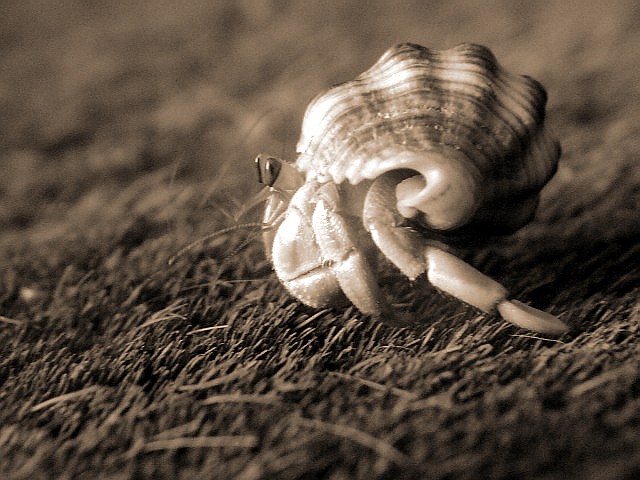
land hermit crab

Photo: Vanessa Pike-Russell/Creative Commons/Flickr

Laughing babies meet hermit crabs in two haiku by Stella Pierides in today’s feature of the International Women’s Haiku Festival.

juggling
a pen and a feeding spoon –
the baby’s laughter

This senryu captures a moment of the happy chaos babies bring with them everywhere.  The baby is probably laughing because he or she feels secure and happy in the presence of a familiar care taker.  But what about this whimsical possibility: The baby laughs along with us at the humorous image of the parent “juggling” pen and feeding spoon?  In any event, this laughing baby, like all laughing babies, gets the last laugh – from us.

***

hermit crab –
while ironing she dreams
of other lives

Confined to its shell, the hermit crab rarely, if ever, leaves its home.  What if the woman in this haiku could leave her shell and leave behind her domestic chores?  Would the “other lives” of which she dreams live up to her fantasies and justify sacrificing the security of her status quo?  Maybe what the woman really wishes for is simply to know she has the freedom to choose a different path and define herself anew.

Stella Pierides was born in Athens, Greece and now divides her time between Neusäss, Germany, and London, England.  She is the author of Of This World (Red Moon Press, 2017); In the Garden of Absence (Fruit Dove Press, 2012), for which she received a Haiku Society of America Merit Book Award; and Feeding the Doves (Fruit Dove Press, 2013), among others.  Stella serves on The Haiku Foundation board of directors and project manages the Per Diem: Daily Haiku feature for the Foundation. She enjoys reading, gardening, film, music, food, and working long hours.

Find more information about the International Women’s Haiku Festival and submit your work at this link.

International Women’s Haiku Festival: Poems by Martha Magenta

20150205_163920.jpg

Photo: Mo Barger/Creative Commons/Flickr

Martha Magenta turns mammogram shadows upside down and sees dignity in dementia in today’s feature of the International Women’s Haiku Festival.

mammogram
my shadow
leads the way

Shadows usually follow us, not lead us.  Magenta’s turning that truth on its head is wonderfully playful – or would be, if the shadow in question weren’t the shadow on the mammogram image that every woman dreads.

***

knitting a shawl
grandmother folds
into the fog

This poem is a rich and dignified picture of generational role reversal.  The verb “folds” so gently unites the knitting work-in-progress with the grandmother who is fading into the fog of sleepiness or dementia – or both.  Was it perhaps the grandmother who taught the poetic speaker to knit?  If so, then those stitches weave the speaker and the grandmother together through the DNA of a beautiful handicraft passed down through generations.

Martha Magenta lives in England, UK. Her poetry has appeared in The Reverie Journal, Cafe Aphra, and Beaux Cooper; her haiku and senryu have been published in Modern Haiku, Presence, and Chrysanthemum, among others; her tanka in The Bamboo Hut, and Ribbons. She is owner of POETS community on G+. She collects her published work on a blog: https://marthamagenta.com/.

Find more information about the International Women’s Haiku Festival and submit your work at this link.

International Women’s Haiku Festival: Poems by Michael Dylan Welch

Cedar Forest

Photo: Jerry Meaden/Creative Commons/Flickr

Michael Dylan Welch writes of cedars and doilies in today’s feature in the International Women’s Haiku Festival.

rust in the cedars –
we gather again
at her favourite spot

Whose favorite spot?  A grandmother’s?  A sister’s?  A friend’s?  We don’t know, but the “rust in the cedars” and the ritual (“again”) gathering suggest the remembrance of someone now gone.  This poem rings with music: The musical sibilants in the first line – “rust in the cedars” – open the poem with a reverential whispering.  The assonance of the hard G’s on both accented syllables in the second line – “we gather again” – is a gently percussive counterbalance to the hushed first line.  There seems to be a stillness at this gathering, a moment in which to contemplate the imponderable realities of interconnection and the cycle of life.

***

lazy day at granny’s –
the doily imprint
on my daughter’s cheek

There’s an entire world in the 11 words of this senryu.  This granny with her doilies – you can see her furniture, you can hear the creak of her floors.  And the filigreed imprint of the doily on the girl’s cheek connects the girl with that family home, a sanctuary of complete and total safety.  The assonance and swung rhythm of “lazy day” intertwines seamlessly with the alliteration of “day,” “doily,” and “daughter,” uniting musically the people, time, place, and mood of a moment of simple yet profound family joy.

Michael Dylan Welch recently served two terms as poet laureate for Redmond, Washington, where he also curates two poetry reading series and directs the annual Poets in the Park festival. He runs National Haiku Writing Month (www.nahaiwrimo.com), and is a director of the biennial Haiku North America conference. Michael’s haiku, tanka, longer poems, essays, and reviews have appeared in hundreds of journals and anthologies, and one of his translations appeared on the back of 150,000,000 U.S. postage stamps. His personal website is graceguts.com. Michael lives with his wife and two children in Sammamish, Washington.

Find more information about the International Women’s Haiku Festival and submit your work at this link.

International Women’s Haiku Festival: Poems by Shloka Shankar

HPIM0944a

Photo: Michael Koolman/Creative Commons/Flickr

Shloka Shankar writes of goddesses and Rorschach tests in today’s feature of the International Women’s Haiku Festival.

omniscient narrator the goddess in me awakes

The poetic speaker’s mind generates a metanarrative of the population of her inner landscape.  At once, she is narrator and goddess and all of those other characters who live in her soul.

***

Rorschach test
the side you choose
to ignore

This poem lays bare the reality of our human hypocrisy.  We believe what we want to believe.  Especially about ourselves.

Shloka Shankar is a freelance writer from Bangalore, India.  She has happily found her niche in found poetry and Japanese short-forms alike.  Her work has appeared in close to 200 print and online venues of repute.  She co-edited naad anunaad: an anthology of contemporary world haiku (Vishwakarma Publications, 2016) and is a Best of the Net nominee.  Shloka is the founding editor of the literary & arts journal Sonic Boom.

Find more information about the International Women’s Haiku Festival and submit your work at this link.

International Women’s Haiku Festival: Haiku by Willie R. Bongcaron

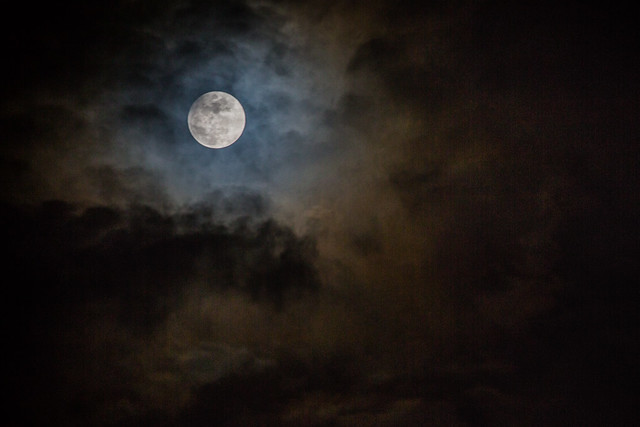
The moon

Photo: Laurie Shaull/Creative Commons/Flickr

The International Women’s Haiku Festival continues with a lovely haiku about solitude by Willie R. Bongcaron.

full moon
she stands alone
not so lonely

This poem gives graceful voice to a vexing issue.  Traditionally, women have been defined – and often still are defined – by their relationships with the men in their lives.  In the West, at least, daughters take their father’s last names, and traditionally, women take their husband’s last names.  When a woman is unattached, and in particular, not married to a man, does the world accept her as the complete human being she is, or does she tend to be viewed simply as someone who lacks a spouse?

In Bongcaron’s poem, the moon reflects the radiance of a woman comfortable in her solitude, a woman who stands on her own two feet, well at ease.

Willie Ropelos Bongcaron is a haijin by choice.  He has adopted a pen named AoSuzume, or the blue sparrow, with the help of Ms. Gabi Greve.  He is an adherent of short poetry forms like haiku, senryu, tanka, haiga, free verse, etc, but has been particularly addicted to haiku and senryu for 5 or more years now.  He resides in Sampaloc, Manila, the Philippines with his family; and is a government employee, having worked with the light rail transit system (LRTA) since 1985.

Find more information about the International Women’s Haiku Festival and submit your work at this link.

International Women’s Haiku Festival: Terri L. French

dark alley

Photo: Renee McGurk/Creative Commons/Flickr

Terri L. French talks homelessness, lip service, and tampons in today’s feature in the International Women’s Haiku Festival.

curses–
a homeless teen
stealing tampons

The Curse, that monthly guest, joins up with the dreaded curse of homelessness and all the woes that fly out from its Pandora’s box.  French captures the desperation of the impoverished young woman with a boldness and directness that hits you in the gut and makes you weep for the world.

***

lip service
her voice falling
on deaf ears

The phenomenon of what I call disenvoicement – the unjust silencing of an individual on real or perceived threat of devastating consequences for speaking out – is a sinister reality in the lives of women.  In so many ways a woman’s voice falls on “deaf ears” – the physically or emotionally abused woman or girl is afraid to speak out against her abuser, the professional woman is afraid to speak from her unique perspective in a meeting full of male colleagues, the silenced woman who, in some cultures, is viewed as a being without basic human dignity simply by virtue of her sex – the list goes on.  This tragedy plays out on the social and individual levels; how much worse off the world is when deprived of these voices!  French’s poem aptly gives voice to a grave wrong in women’s experience that has gone on far too long.

Terri L. French is a writer/editor and award winning haiku poet living in Huntsville, Alabama. She is past Southeast Coordinator of the Haiku Society of America, former editor of the senryu and kyoka journal Prune Juice, and current secretary for The Haiku Foundation.

Find more information about the International Women’s Haiku Festival and submit your work at this link.